

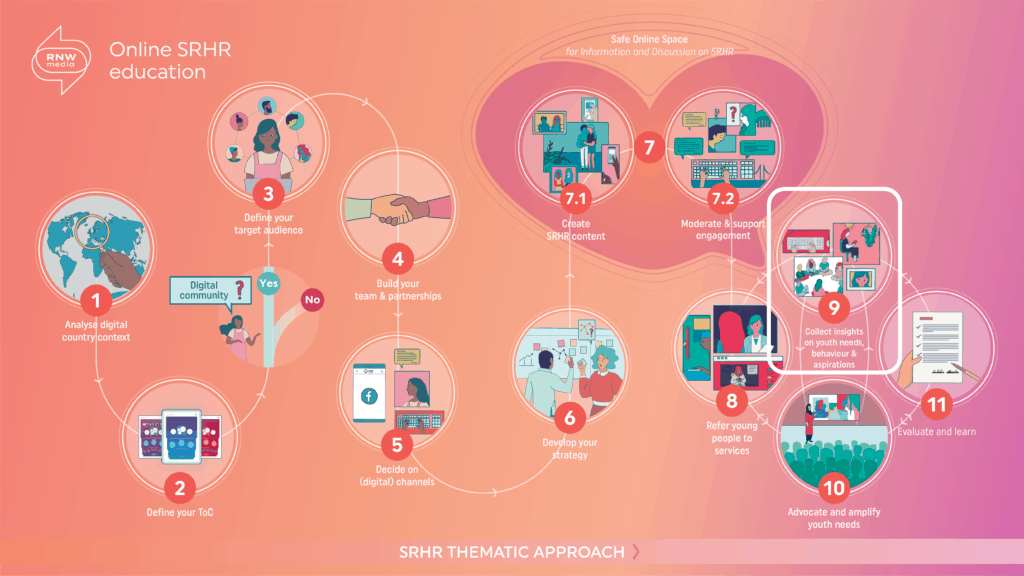
Welcome to the 9th module in the roadmap to build digital communities for social change: collect insights on youth needs, behaviour and aspirations.

Purpose
Through our offline and online communities, we can collect valuable information about young people’s needs, interests, opinions, behaviour and aspirations. The insights on youth needs, behaviour and aspirations can be used to optimise your own programme and content creation, it can help you determine the objective of your online and offline campaigns, and can be shared with a broader audience, for example with other media organisations to amplify youth voices, or with policy makers as part of your advocacy activities.
There are many ways of collecting data, but in this module, we will cover the methods that are frequently used at RNW Media, namely: social listening, social media analytics, surveys and focus group discussions.
Once you have gathered the valuable insights, and you want to share your information with your (digital) community, the media or maybe policy makers as part of your advocacy activities, you need to think about ways to present these insights. How you present your data will be key in how your message is understood. To be able to communicate your message in the most effective way, we conclude this module with how you can visualise your data.

Learning Goals
After completing this module, you will be able to:
- Define your data needs
- Distinguish between RNW Media’s frequently used data collection methods
- Be aware of how different data collection methods work
- Select relevant data collection methods
- Consider legal and ethical measures to collecting data
- Be aware of the importance of communicating your insights to stakeholders

Learning Journal Reflection
Think about an example of your team’s experience with collecting data on youth needs. Write down in your learning journal:
- What was the purpose of the research?
- How did you collect data and what kind of data did you collect?
- What would be an upcoming project or activity In future where a data collection on youth needs helps you to make an Informed decision? (Think or quickly check with your colleagues, e.g. programme optimization, content creation, online & offline campaigns a presentation for policy makers as part of your advocacy activities.)
RNW Media Resources
- PMEL Digital analytics training video on website analytics with google analytics
- SRHR Impact on USERS - June 2020 infographic
- Social listening
- What-is-Social-Listening.mp4.mp4
- 20191001_Social Listening Strategy.pdf
- 20191001Social Listening Strategy_736523052.pdf
- Decision tree - What tools do I need.pdf
- Brandwatch
- Introduction to Brandwatch - a tool for SL.mp4
- Brandwatch Showcase 16 Days of Activism 2019.pdf
- Brandwatch Manual.pdf
- Tracking Instagram hashtags with Brandwatch.pdf
- Surveys
- RNW Media Brief Guide to Making Surveys 1_1944438648.pdf
- RNW Media FGD Toolkit
- FGD toolkit - 1 - Guidelines.pdf
- FGD toolkit - 2 - Preparation template.docx
- FGD toolkit - 3 - Discussion Guide template.docx
- FGD toolkit - 4 - Note-taking template.docx
- FGD toolkit - 5 - Consent Form English.docx
- FGD toolkit - 6 - Consent Form French.docx
External Resources
- Social media analytics
- Data visualisation resources
- The value of data visualisation
- Pace toolkit on data visualisation
- Data visualisation linked to advocacy
- The work of Edward Tufte and graphics press
- CAIRO: A weblog about information design and visualisation
- Visualising data
- Your guide to great graphs
- Visualising data for Human Rights advocacy
- Chart guide