
Outcome Harvesting

This section is mainly based on these sources: 1 & 2.
Outcome harvesting is a different type of evaluation. While “traditional” forms of evaluation tend to measure if predetermined objectives and outcomes have been achieved, outcome harvesting collects (“harvests”) evidence on what has changed (outcomes) and then works backward to determine if and how a campaign or intervention contributed to these outcomes. Outcomes can be positive or negative, intended or unintended, but the connection between the initiative and the outcomes should be verifiable.
An outcome is defined as:
| An observable change in agenda, activity, relationships, policy or practice in another actor to which the programme has contributed – partially or wholly, directly or indirectly, intentionally or not. |
When to Use Outcome Harvesting?
Outcome harvesting can be a useful tool for monitoring and evaluation, when:
- The focus is on outcomes and why they happened, rather than on whether activities were carried out as planned.
- In complex situations where the relation between cause and effect are unclear, or and/or where many different actors influence change. This approach can help to understand how individual outcomes contribute to broader system-wide changes (for example in advocacy, campaigning, and policy work).
- For monitoring and evaluation, to learn about the change and understanding why those changes occurred.
Outcome Harvesting Process
Outcome harvesting is a participatory process that involves the following stakeholders:
- Change agent: Individual or organisation that influences an outcome (organisation implementing the project or programme).
- Social actor: Individual, group, community, organisation, or institution that changes as a result of a change agent intervention.
- Harvest user: The individual(s) who require the findings of an Outcome Harvest to make decisions or take action. This may be one or more people within the change agent organisation or third parties such as a donor.
- Harvester: Person responsible for managing the Outcome Harvest, often an evaluator (external or internal).
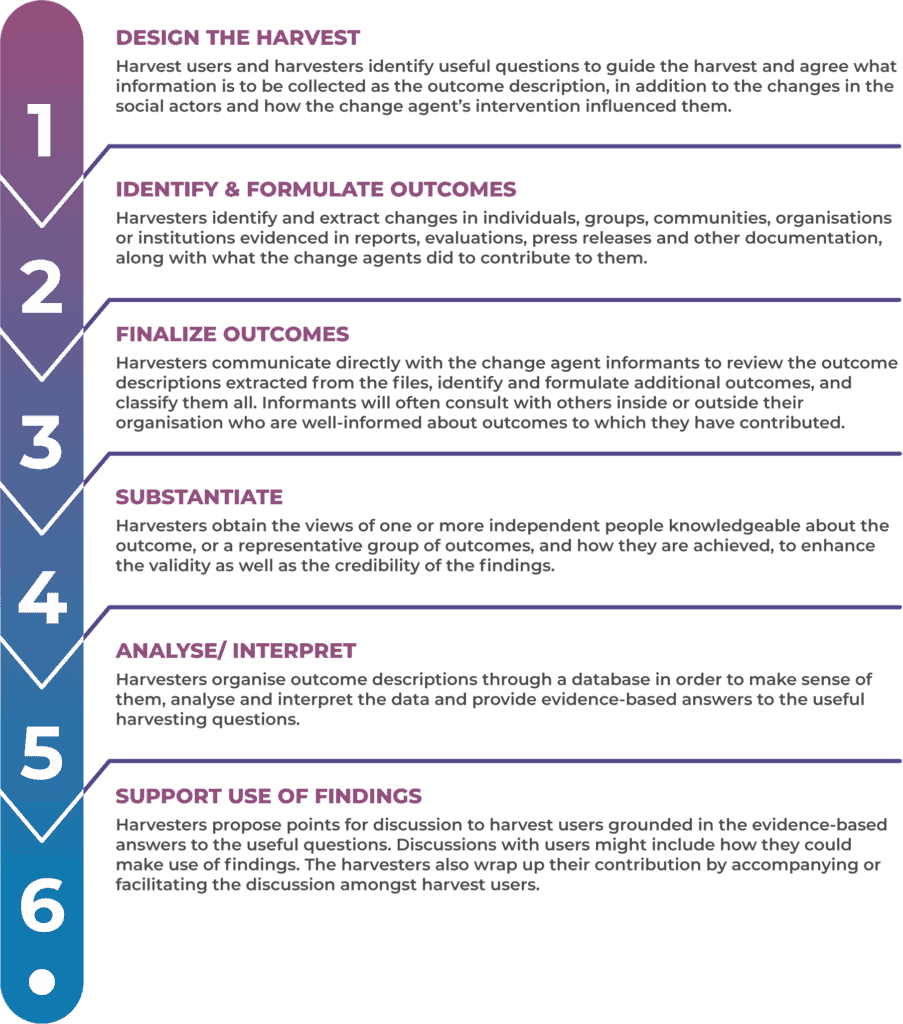
Outcome harvesting can be applied by following the 6 steps/guiding principles:
How to Identify and Formulate Outcomes
The step-by-step process detailed above, should lead to the formulation of validated outcome descriptions. The key elements that need to be included in every outcome description are:
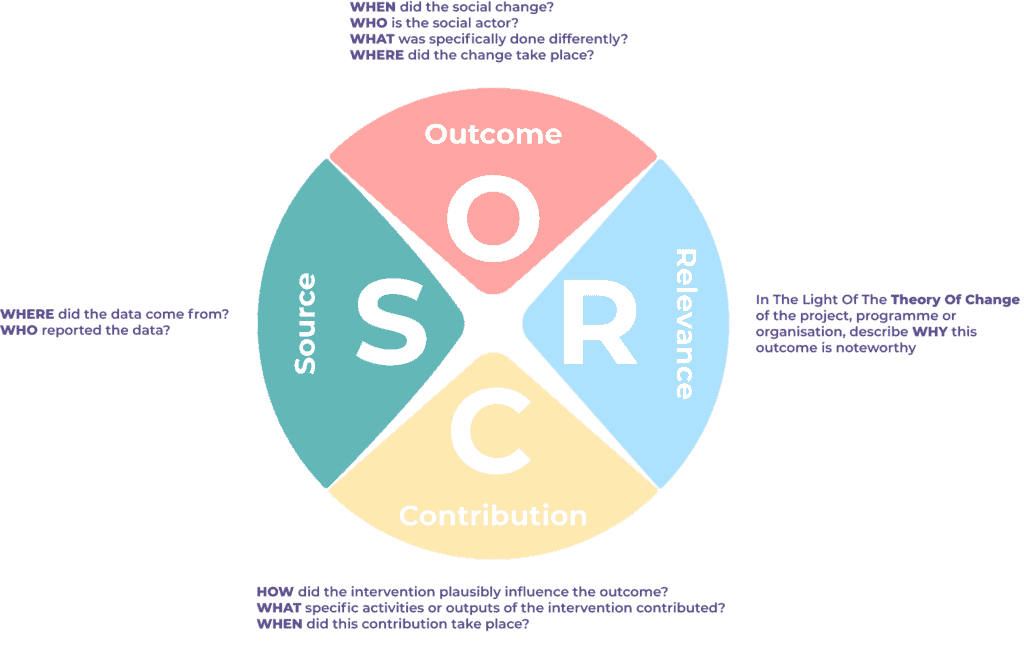
- Outcome description: Who changed what, when and where?
- Relevance/significance: The importance of the outcome in the light of the campaign objectives
- Contribution: What activities and outputs contributed to the change described in the outcome. This contribution can be direct or indirect, small or large, intended or unintended.
- Sources: The specific documents and people who provided the data.
Outcome harvesting is particularly useful in complex situations that involve multiple social actors, where it is more difficult to understand the direct cause and effect relation, what was achieved and how it happened. Examples of such complex situations, include initiatives in the field of campaigning, advocacy and social change processes.
Various sources, such as reports, previous evaluations, press releases and other documentation, can be used to identify potential outcomes (changes in individuals, groups, communities, organisations or institutions) and what the intervention did to contribute to them. In this exercise, you will create your own outcome description. This can be done by – after identifying a source to use – asking a relevant question that you would like to answer. For example: What has been the collective effect of grantees on making the national governance regime more democratic and what does it mean for the programme’s strategy?
The most important next step is to obtain information about the changes in social actors and how the intervention influenced them. The change, in the case of this example, can be a president’s public commitment to being transparent (behaviour); the legislature passing a new anti-corruption law (policy); or a third successive government publishing its procurement records (practice). The influence of the change agent can range from inspiring and encouraging, facilitating and supporting, to persuading or pressuring the social actor to change.
Exercise: Review documentation and draft your outcome description. What question can you ask to guide your statement? What is the outcome, or observable change in agenda, activity, relationships, policy or practice in another actor? How has your intervention contributed to the change (this can be partially or wholly, directly or indirectly, intentionally or not)? To write down your description, you can either click below for a template or create one yourself.