Mapping Political Actors Copy
Sources: Link for Political Mapping How to Guide by GRSP
Mapping the political actors is crucial for an advocacy campaign. It is important to identify key politicians and assess their persuadability, compatibility, political affiliations, and stance on the issue. Explore past interviews to understand their perspectives and identify pressure points.
Guiding questions
- Can I effectively persuade the politician?
- What is their political affiliation?
- Are we aligned in terms of political parties or opinions?
- How do they relate to the topic in terms of voting patterns and arguments?
- Have they been interviewed on this matter, and if so, what are their expressed views?
Mapping Political Actors: Target Analysis
Source: Link for “Tools for developing an Advocacy Strategy” by Rutgers and Link for Actor Policy Mapping by New Climate
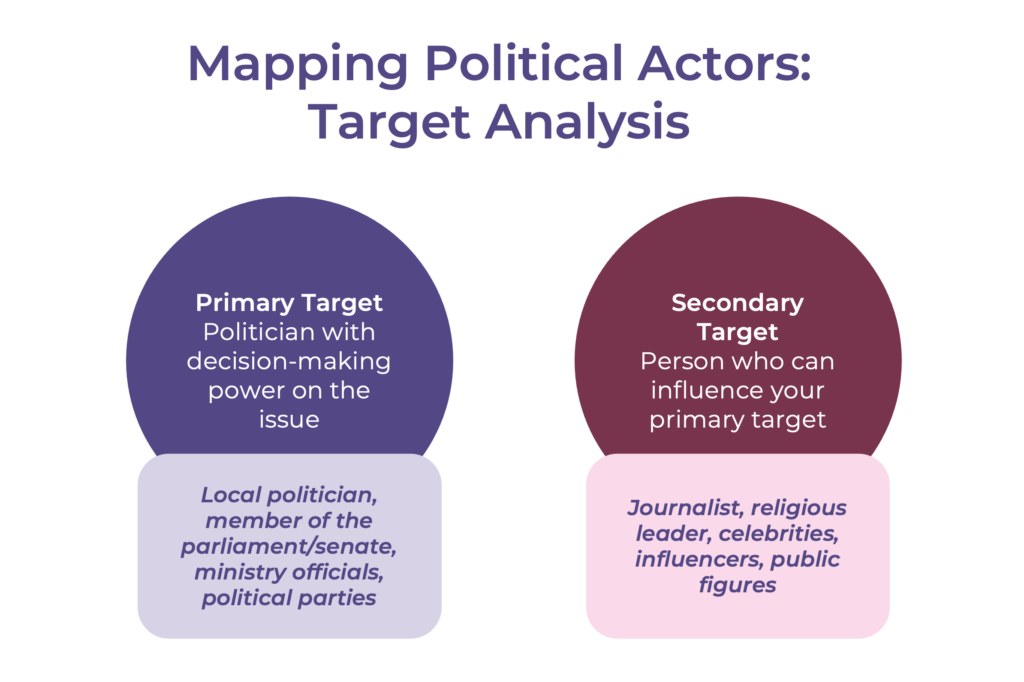
- A (primary) ‘target’ is the person who has the power or authority to help you address your formulated problem and thus achieve the goal of your advocacy campaign. Often this is a person with decision-making power. Who this is depends on your advocacy priority. Common examples of primary targets are local politicians, Members of Parliament, ministry officials or political parties. Think about what institutions — political, governmental, or nongovernmental — influence policies and laws that impact your issue and think of who works there.
- Secondary Target: Sometimes you can/need to target the people who work with or have an influence over that person who holds power rather than the person themself. Those people who can influence your primary target are called secondary targets. Common examples of secondary targets are journalists, religious or faith-based groups or leaders, NGOs, celebrities, influencers and public figures.
You could list the targets in a table such as the one below. It should be a realistic proposition for you to work with each of them. Avoid saying ‘Members of Parliament’ if you know the actual person you should target. Be as specific as possible: which group, which newspaper or which influencer will you target?
Target | Primary or Secondary |
Example 2: Roberto Nuñez: political journalist at Periodico Reforma. He usually covers the government on health related issues | Primary |
Example 2: Roberto Nuñez: political journalist at Periodico Reforma. He usually covers the government on health-related issues | Secondary |
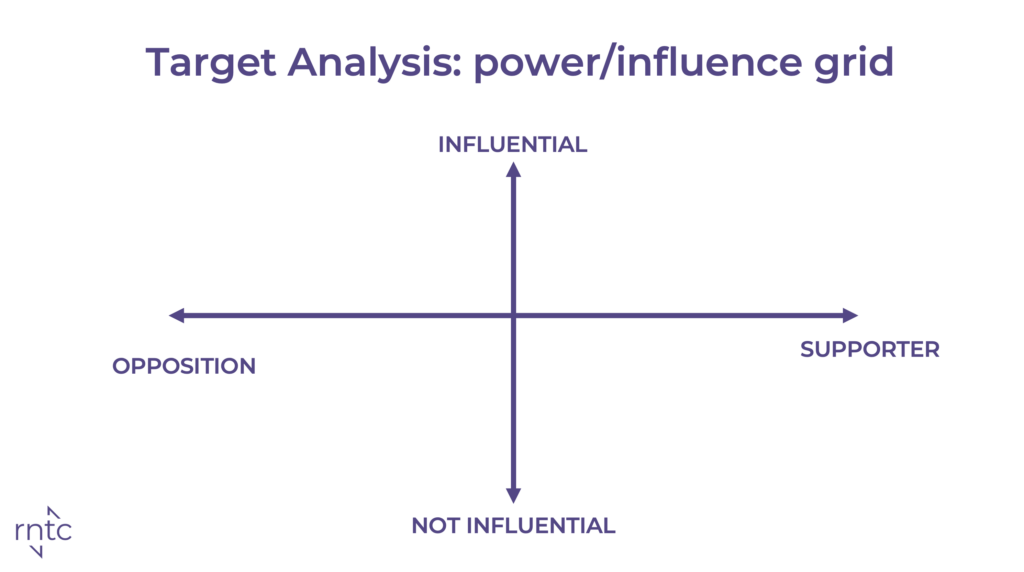
Mapping Political Actors: Target Analysis Power/Influence Grid
After a target analysis to see who can make the change happen, we recommend you do a stakeholder analysis to distinguish between allies and opponents. Not all allies or opponents will have a large impact on what you do, and it is therefore essential to focus on those that you expect to have the greatest impact (positive or negative) on the decision-making process. The matrix is a type of power analysis that can help you map the targets and get an overview of who supports your issues and who has a high influence on them. This exercise works best in a format where you can position and re-position these actors as you think of them together with your colleagues, this might be on a flip chart or poster, or online on a mural or similar online space.