
How do governments actually work? – Policy Accountability Copy

The basic step for advocacy is to understand how laws and policies are decided and implemented in the government relevant to the context
Law and Legislation:
Law: Law refers to a system of rules and regulations that are recognized and enforced by a community or society. Laws are created by legislatures and enforced by governmental bodies or authorities. They serve to regulate conduct, resolve disputes, and protect the rights of individuals.
Legislation: Legislation specifically refers to the process of making or enacting laws. It involves the proposal, debate, and enactment of laws by a legislative body, such as a parliament or congress.
Public Policy:
Public policy encompasses the principles, goals, and actions that a government or organization undertakes to address issues and achieve specific outcomes. It reflects the decisions and strategies adopted by policymakers to address societal challenges and promote the public interest. Public policy can cover a wide range of areas, including social, economic, environmental, and foreign policy.
If your topic is not yet stipulated, (freelancing, digital rights, etc) the advocacy aim can be to push the conversation and start drafting legislation. A first approach to identifying the governmental department under which your problem falls, you must first:
- Government Structure: Understand the organizational structure of the government at the local, regional, or national level. Different issues may fall under different departments.
- Policy Documents: Examine relevant policy documents or strategic plans that outline the government’s areas of responsibility.
Policy Accountability Cycle
Source: Link for Policy Accountability Cycle by Rutgers
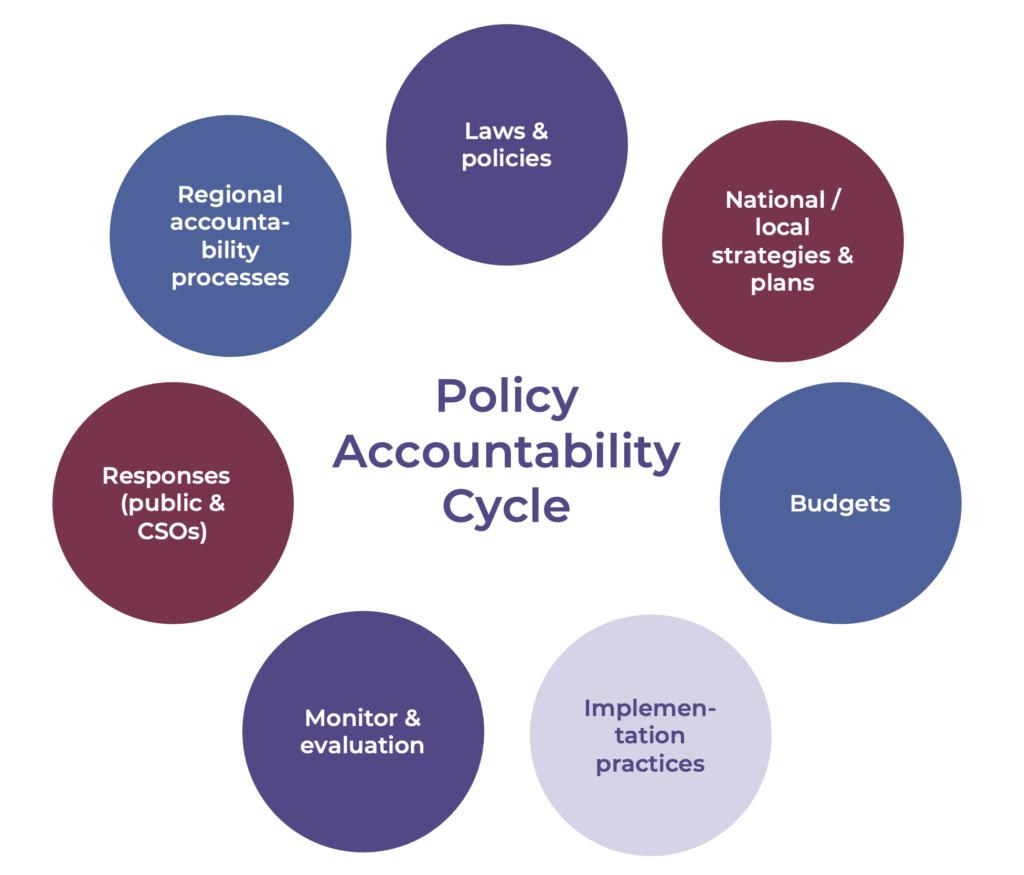
This policy accountability cycle was developed by Rutgers and derived from the Office of the High Commissioner for Human Rights. It sheds light on where could an advocacy goal focus its efforts on, depending on the political context:
1. Laws and Policies:
- Importance: Understanding existing laws and policies related to the social issue is crucial to identify gaps, weaknesses, or areas that require reform.
- Advocacy Goal: Advocates may aim to influence or change existing laws and policies to better address the issue.
2. National & Local Strategies and Plans:
- Examining national and local strategies provides insights into the government’s planned approaches to address social issues.
- Advocacy Goal: Campaigners may seek to align their advocacy with or influence the development of strategic plans to ensure inclusivity and effectiveness.
3. Allocation of Budgets:
- Understanding budget allocations reveals the financial commitment to addressing the social issue.
- Advocacy Goal: Advocates may advocate for increased funding or reallocation of resources to prioritize their cause.
4. Implementation Practices:
- Evaluating how policies are put into practice helps identify gaps between theory and implementation.
- Advocacy Goal: Campaigners may advocate for improved implementation strategies or changes in practices to enhance effectiveness.
5. Monitoring and Evaluation:
- Monitoring and evaluation mechanisms assess the impact of policies and interventions.
- Advocacy Goal: Advocates may push for robust monitoring and evaluation practices to ensure accountability and evidence-based decision-making.
6. Responses from the Public:
- Public reactions provide real-time feedback on policy effectiveness and societal perceptions.
- Advocacy Goal: Campaigners may leverage public sentiment to advocate for policy changes or improvements.
7. Regional and International Processes:
- Understanding regional and international commitments sheds light on global standards and expectations.
- Advocacy Goal: Advocates may align their campaigns with international standards or leverage global platforms to exert pressure.
8. Accountability:
- Assessing accountability mechanisms ensures that responsible entities are answerable for their actions.
- Advocacy Goal: Campaigners may advocate for strengthened accountability mechanisms to ensure transparency and responsibility.
By analysing each stage in the policy accountability cycle, campaigners can strategically intervene at different points to advance their advocacy goals.
Why integrate an advocacy strategy into your campaign?
While narratives play a crucial role in influencing behaviour and ways of being, advocacy broadens the approach, addressing systemic issues and advocating policy changes for sustained impact at the societal level. While a media campaign primarily focuses on influencing behavioural change through communication and awareness-building, an advocacy strategy can provide a broader framework for addressing systemic issues and driving policy changes that support and sustain the desired behavioural changes. The synergy between media campaigns and advocacy strategies can lead to more comprehensive and sustainable social change.
CASE STUDY – SUNRISE MOVEMENT: ” WE’RE A MOVEMENT OF YOUNG PEOPLE FIGHTING TO STOP THE CLIMATE CRISIS AND WIN A GREEN NEW DEAL. Together, we will force the government to end the era of fossil fuel elites, invest in Black, brown and working-class communities, and create millions of good union jobs. We’re on a mission to put everyday people back in charge and build a world that works for all of us, now and for generations to come.”

Source: Link to Case Study: “Sunrise Movement”
How do narrative change and advocacy complement each other?
- Amplification of Message: A media campaign can create widespread awareness and understanding of the behavioural changes being promoted. An advocacy strategy can further amplify this message by targeting decision-makers, stakeholders, and the public to garner support and push for changes at a policy level.
- Policy Change: While a media campaign encourages individual behavioural change, some issues require changes in policies, laws, or regulations for sustainable impact. An advocacy strategy can advocate for these changes by mobilizing public support, engaging with policymakers, and providing evidence from the media campaign to demonstrate the urgency and importance of the issue.
- Scale and Sustainability: A media campaign can initiate behavioural change among individuals, but an advocacy strategy can help scale up the impact by institutionalizing the desired changes. Policy changes influenced by advocacy efforts can ensure that the desired behaviours are supported by a conducive environment, resources, and regulations.
- Addressing Root Causes: Media campaigns often address symptoms of larger social issues. Advocacy strategies can address the root causes by advocating for systemic changes that tackle the underlying problems. This comprehensive approach ensures a more holistic and lasting impact.
- Collaboration and Partnerships: An advocacy strategy can involve collaboration with organizations, experts, and stakeholders working on similar issues. These partnerships can bring additional expertise, resources, and influence to the media campaign, making it more effective and credible.
- Feedback Loop: The insights and data gathered from the media campaign can provide evidence and data to support advocacy efforts. Real-life stories and statistics from the campaign can be powerful tools to advocate for policy changes.
- Momentum: A well-executed media campaign can generate momentum and public interest in an issue. Advocacy efforts can ride on this wave of public attention to push for policy changes and create a sense of urgency.