
Creating Content

Types of SRHR Content
Love Matters provides SRHR content to young people on its platforms, with the aim to reach young people with open, honest and pleasure-positive information on love, sex and relationships in places where such information is often censored or taboo. The next sections detail the type of content that is provided on the Love Matters platforms and provides guidance on how to select the topics you want to cover in your content. This includes assessing your thematic coverage using international guidelines on sexuality education, but also assessing the risks of writing about topics in your specific context while still “pushing the boundaries” when deemed appropriate.
Love Matters has two primary types of content on its platforms: facts and stories. They are designed to work together to offer users the opportunity to find out more about their bodies and sexual functions, and healthy relationships. For example, if a user’s goal was to find out more about Sexual Transmitted Infections (STIs), they can read a fact to understand the health education content and read about people’s personal experiences via story content, and so on.
Facts
Facts, or evidence based SRH information content, is straightforward, objective information about love, sex, sexuality, relationships and the body.
LOVE MATTERS GUIDELINES ON SRHR CONTENT – FACTS
- Fact-based content should be created by a Love Matters SRHR expert and reviewed by another expert from within the Love Matters Global Network. The editors of specific platforms then need to ensure the fact is context-appropriate and fully localised (for example local brand names are used for contraceptives)
- Fact-based content should be simple, free from jargon and wordplay, and easy to understand for low-literacy readers.
- If the source is a scientific article, include a link to the page where it’s available for download, or downloadable PDF.
- Thoroughly check the accuracy of any information you include about sexual health or medication.
- Refer to multiple sources to ensure information is correct.
- Try to use objective and scientific information from reputable sources, including links to the source where possible
- If reputable scientific or medical opinions on an issue are divided, mention this in the article.
Source: Editorial Guidelines Love Matters
The choice of (fact-based) SRHR topics you want to cover on your platform, to ensure content is comprehensive, pleasure positive, evidence- and rights based, depends on your particular context and programme goals. Extensive research has been conducted on sexuality education programmes and it is highly recommended to also refer to international guidelines on what topics Comprehensive Sexuality Education (CSE) programmes should ideally include. For specific technical guidance on CSE please refer to the UNESCO CSE GUIDELINES. Additionally, it is very important to ensure that all fact-based sexuality education information is fully localised for improved understanding and cultural relevance to the users.
Stories
Story content pieces can be opinion pieces, experiences/personal stories, testimonials, agony aunt or “sexpert” articles, fun facts, tips, etc. In these content pieces, you can have a bit more fun, both in terms of the topic and style.
In Love Matters, there are specific guidelines for different story types.
LOVE MATTERS GUIDELINES ON SRHR CONTENT – STORIES
- Change names in personal stories if needed because of the sensitive nature of the content. The subject of the story may use their real name if they choose to, but make sure they understand any potential risks such as unwelcome attention or online harassment. Take care to protect the identity of other people who feature in the testimonial unless you have received their permission to use their real name.
- Choose pseudonyms that are culturally appropriate.
- Stay true to the facts and spirit of the testimonial. It is acceptable to write a testimonial you have heard from a subject as if it is in their voice, but events or details should not be altered. (You may also be writing in a different language than their own.)
- It is not acceptable to make up fictional stories and present them as true stories.
- The testimonial should be factually correct to the best of your knowledge, and you should do your best to verify this as far as possible.
- If you use a testimonial taken from a different Love Matters website, whether in the original language or in translation, you may change names; for professions and places choose to use descriptions (e.g. rural city, office worker) rather than actual places or jobs.
- When anything has been changed you must always use the following disclaimer: This story is true, but names and places have been changed to protect identities.
- Beneath a blog/opinion piece, always include the following disclaimer: The opinions expressed in this piece are those of the author and are not necessarily endorsed by Love Matters.
Source: Editorial Guidelines Love Matters
Pushing the Boundaries
The Love Matters programme is about pushing the boundaries of what is contextually acceptable to discuss in relation to young people’s SRHR in order to provide comprehensive sexuality education. So even restrictive contexts can benefit from small steps in creating more openness to SRHR, minimising taboos and enabling young people to access SRH information and education, while creating opportunities for them to openly discuss their questions and issues in a safe space.
What are the topics that “push the boundaries” that can be addressed in your platform, either through fact or story content creation? This depends on the context your programme operates in and requires a careful assessment of the risks.
How to address taboo or controversial topics?
As the previous assignment has highlighted, there are risks to addressing certain topics in specific settings. This is something various Love Matters partners across countries deal with on a daily basis. Constantly adapting and learning what can and cannot be shared, promoted or published has become a huge part of the daily work for the Love Matters partners. The Love Matters content creators are constantly navigating how to discuss controversial or sensitive techniques with their audience online, always striving to find a balance between opening the discussion and not alienating the users. This censorship is also mediated through the social media giants and internet providers such as Facebook and Instagram, who have the ability to control what information can be shared or distributed further.
How have they dealt with controversial or taboo topics? How have they dealt with (social media) censorship and still made it possible to cover the topics that were important to their users.
ASSESS YOUR RISKS
- Make sure you are aware and assess what the sensitive topics and taboos are in your country and the inherent risks
- Stay up to date on the social media developments and social media platform policies: taking the example of Facebook Ads, it is good practice to familiarise team members with the Facebook guides and policies as they are frequently changed and updated. It’s vital that teams study these guides and policies in order to avoid any block or ad removal
PRIVACY AND SECURITY
- Protect the identity of your users and persons you write about. Avoid using real names if it poses a risk to the person or those related to him or her
- Use private channels and groups to discuss sensitive topics
- Protect the identity of your team- keep your own social media channels hidden and do not give your address
CONTENT FORMATS
- Make issues more fictional
- Use cartoons instead of images of real persons
- Use animations, instead of videos of real persons
- Choose the images carefully, assessing the risks of possible rejection or blockage
LANGUAGE USE
- Be aware of the sensitive words and use alternative/or similar words in your content: In China, for example, Facebook is banned but our Love Matters partners face the same challenges with local social media channels such as WeChat and must also find ways to circumvent the country’s strict censorship. A frequent approach is using alternative words, such as ‘little brother’ to refer to penis and ‘little sister’ to refer to vagina – terms that are understood by users. The team is constantly on the alert for workarounds as new words and phrases are added to the country’s automated content filters. (Facebook and SRHR censorship, Love Matters)
- Use local languages to avoid your content gets blocked. See the examples below of possible Facebook advert rejections and possible mitigation strategies related to language. Please note that the rejections of ads play out differently across regions. What might work for one Love Matters platform, might not work for another.
SENSITIVE SRHR TOPICS | STRATEGIES TO AVOID AD REJECTIONS |
Sexual relationships | Use more conservative terminology. As employed by Love Matters Arabic, as Elhosseiny mentions: “Anything that has a sexual context will most likely be disapproved. […] Sometimes, we are playing with words. Instead of saying sexual relationship we would, for example, say marital or intimate relationship,” (Facebook and SRHR censorship”, Love Matters) . |
Gender-Based Violence (GBV) | Use local language, slang and lingo – rather than English to discuss more sensitive topics (harder to detect for human moderators and algorithms) e.g. Kiswahili by Love Matters Kenya. Avoid using visuals or graphs that depict violence in any form, as the content will be rejected despite the fact that it is focused on creating awareness of the issue with a view to ending violence. |
LGTBQ-related content | Use local language, slang and lingo – rather than English to discuss more sensitive topics. |
Content related to the vagina (e.g., vaginal discharge) | Use local language, slang and lingo – rather than English to discuss more sensitive topics. Love Matters Kenya, for instance, uses Swahili or local slang to avoid English words such as “sex” or “vagina”. As Social Media Editor Fiona Nzingo explains, “A Kenyan would understand, but someone from Facebook’s HQ would be wondering what it means, and it is hard to notice and find translations of these words”. |
Menstruation | Use local language, slang and lingo – rather than English to discuss more sensitive topics. |
TIMING OF CONTENT
- Choose your timing of posting your content wisely – some dates are more suitable than others (in relation to national events/holidays): In Ramadan, during fasting hours from sunshine to sunset, fasting Muslims are not eating or drinking or having sex. Love Matters Arabic website visits usually drop in first two weeks of Ramadan and that is why we don’t run any campaigns during Ramadan as it not a good time to educate people about sexuality when they are fasting. Similarly, there tends to be a significant traffic surge in the weekend following the end of Ramadan and this time slot offers a golden opportunity for Love Matters Arabic to run a campaign and educate people about sexuality.
- Avoid publishing too many Facebook ads in a short time: From Data Analysis: it seems that when one ad gets rejected then subsequent ads will get rejected for the same reason. Therefore, it might be useful to avoid publishing several ads on one day, instead, leave some time in between publishing different ads to ensure they get reviewed separately. Another option if an ad is tagged as ‘sexual content’ is to create another ad instead of trying to edit the banned one.
Audience Engagement
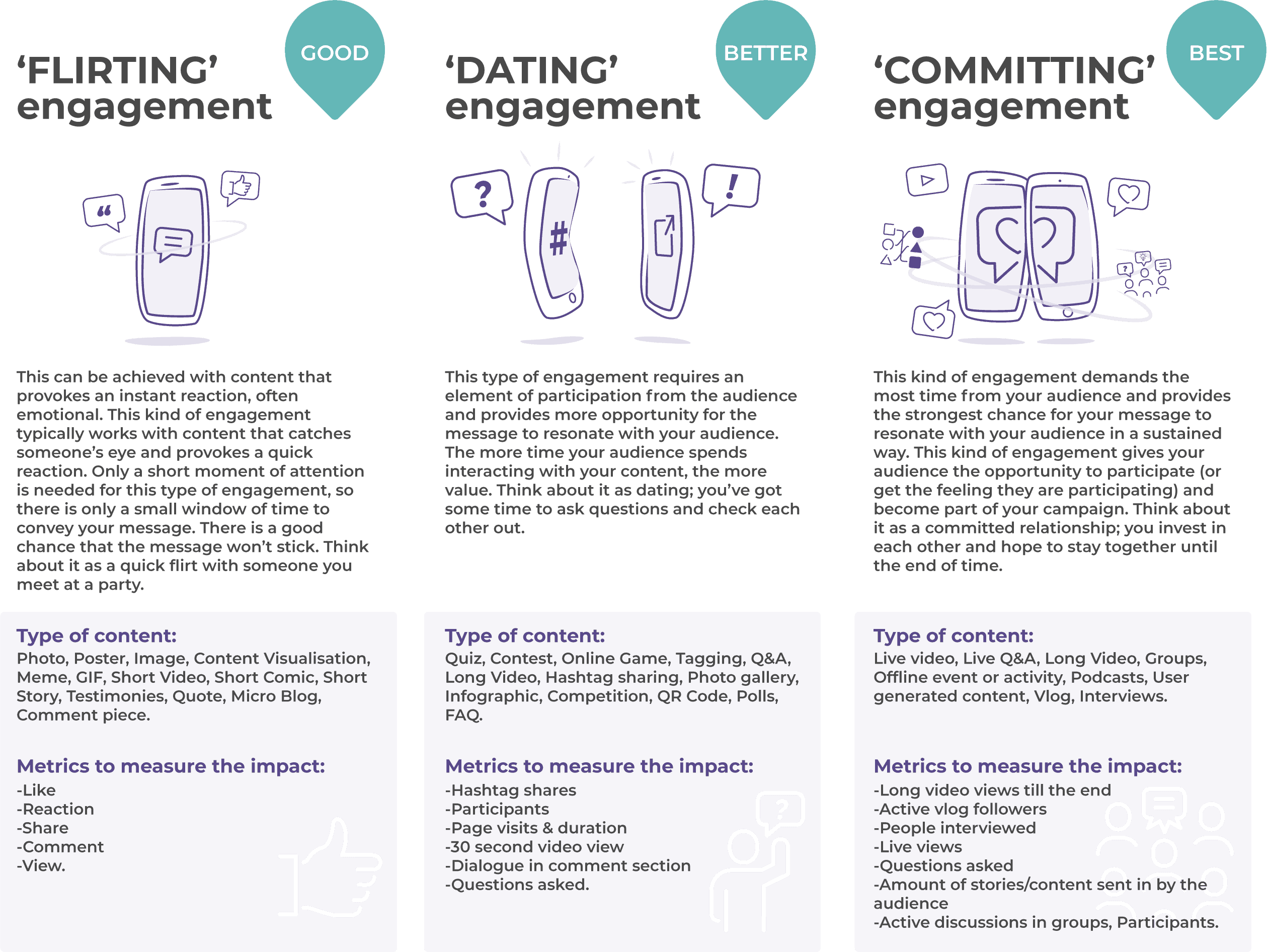
Different types of content will get a different type of engagement from your audience and will give you a different metric to measure. Some metrics are more valuable than others when it comes to assessing the success of your campaign.
For example: A long discussion between people in the comment section gives you better insights than a simple like on a post. Or a 30-minute video that people watch till the end gives you a better chance to tell your story than a 3 second GIF. There are roughly 3 types of engagement:
Virality
Going viral is on the top of the wish list of most campaigners. In fact it’s just another way of saying you want your audience to engage with your posts. ‘Virality’ doesn’t happen to very many posts and no one really knows exactly why a post on Facebook or YouTube catches on.
Campaigners spend some time ‘reverse engineering’ viral posts and trying to work out why it happened. And while there are some tips, the truth is there is no “magic formula”. Many of the things that work for some campaigns will not work for others and sometimes posts go viral without much planning at all.
In this section, we will introduce you to some things you can do to increase your chances of virality. Some posts are more likely to go viral than others either because they have certain features or because they work well within social media algorithms. There are therefore both algorithmic and organic ways to be promoted. If you want to know more about going viral, you can listen to this podcast with media maker Issa Shaker on the subject.
Algorithmic Promotion
- Rich Content: Algorithms prefer content that consists of different media formats (sound, video and images) used at the same time and place
- Variety: Use the whole platform instead of just one feature (for example, on Instagram that means using the feed, live, stories, IGTV)
- Immediate Engagement: If there are a high number of interactions within the first 5 minutes, you post is more heavily promoted
- Consistency: Regular posting and usage of the platform is rewarded
- Distance: You are more likely to be promoted if you are within 10km of your audience
- Response Rate: If there are replies, likes and comments within the first 20 minutes and you engage the audience and stimulate conversation, you can increase the promotion of your post
- Appropriate Length: On Facebook, posts linking to articles between 2,000 and 2,500 words get 15% more shares than shorter or longer articles. LinkedIn goes even longer, getting more shares for articles between 3,500 to 4,000 words long. Make your posts right for the channel and the audience.
Organic Promotion
- Motivational posts: There are many many motivational quotes or sayings on your Facebook newsfeed or Instagram account. Why do those things pop up almost daily in your networks? People feel a psychological need to share inspirational quotes or motivational sayings.
- Amazing news: People like to be the first to share something amazing with their friends. If it challenges the norm, delivers important news, or confirms a myth, all the better. Or even just makes people feel happy and positive. If you do post amazing facts, images or videos, make sure they are legitimate. Do your research before you share so that it doesn’t dent your credibility.
- Amusing posts: Making people laugh is always a good way to get people to share on social media. Laughter reduces stress, increases energy, and creates a bonding moment for people. However, getting a laugh or a share is not enough. You also want to build people’s recognition of your work, awareness of the issues, and trust.
- Quizzes/Games: Very few people can resist joining a simple game like a quiz, especially one that provides (or claims to) a glimpse into your personality. Quizzes have been the most engaging type of content on Facebook, generating the most shares. People have an inherent desire to compare themselves to other people. There are quite a few sites that offer ready-made quizzes you can embed on your social networks, or you can create your own. It doesn’t have to be very complicated as long as it is something you wouldn’t hesitate to take yourself.
- Advocacy Posts: Social issues make people interested, especially if they can do something to help support you. So if you post advocacy-related content, make sure to include a call to action.
- Hashtags: To reach people that aren’t in your networks, hashtags can be very useful. Anyone who uses or searches your hashtag can view your post and potentially share it. Using hashtags doubles your engagement on Twitter and Instagram, which usually means shares as well. On Facebook, however, hashtags can actually reduce reach, so know your platform.