Planning Copy
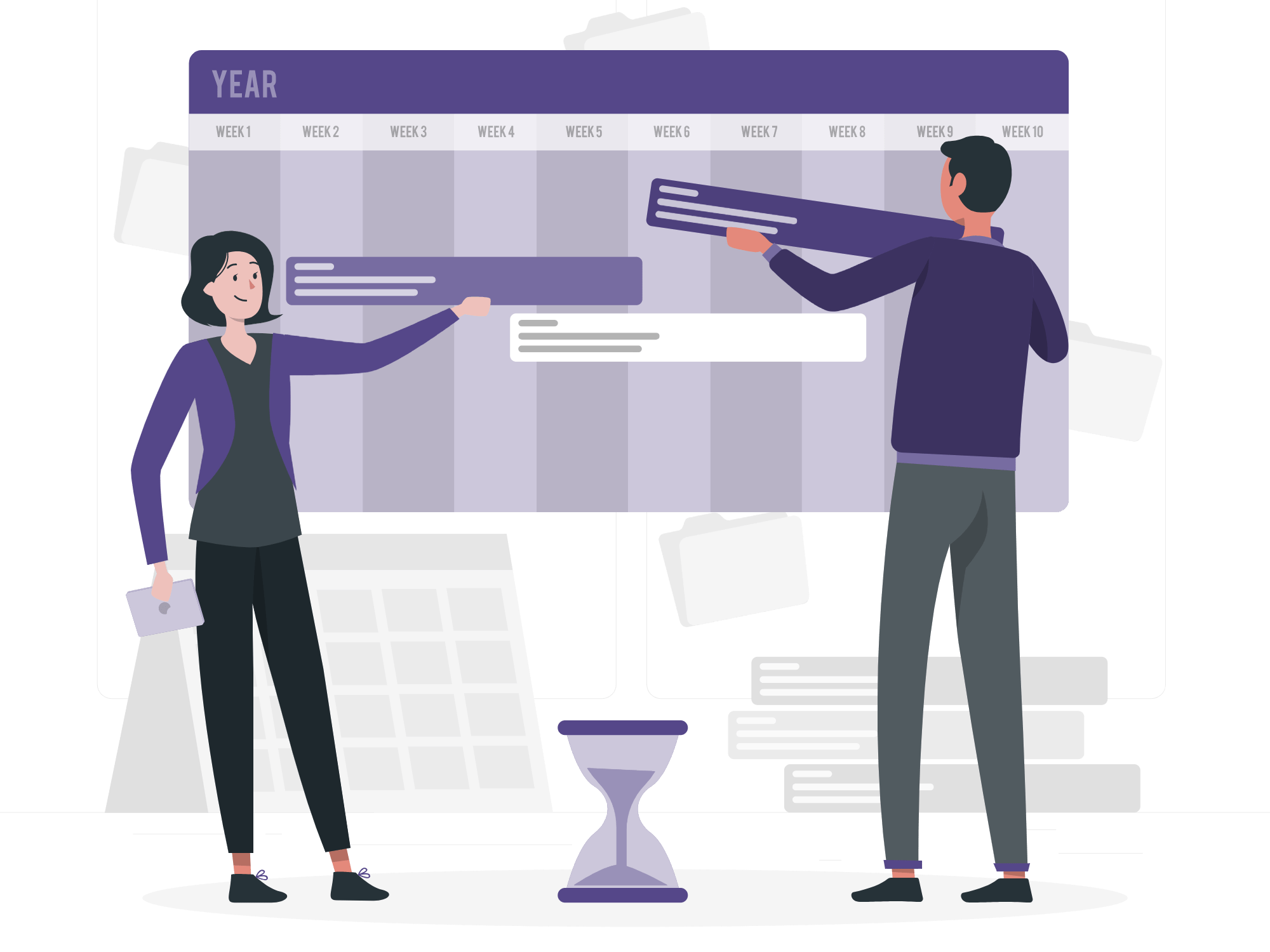
In this phase, we define our project and do a needs assessment (if we do not have all the information). Based on the Theory of Change, an appropriate and manageable indicator framework or logical framework needs to be developed (see section on Monitoring for more details on indicators).
The planning phase is also the phase where we collect baseline data. Baselining is extremely important, because it enables us to measure differences (e.g. in knowledge, behaviour, skills,) before and after the project, or impact.
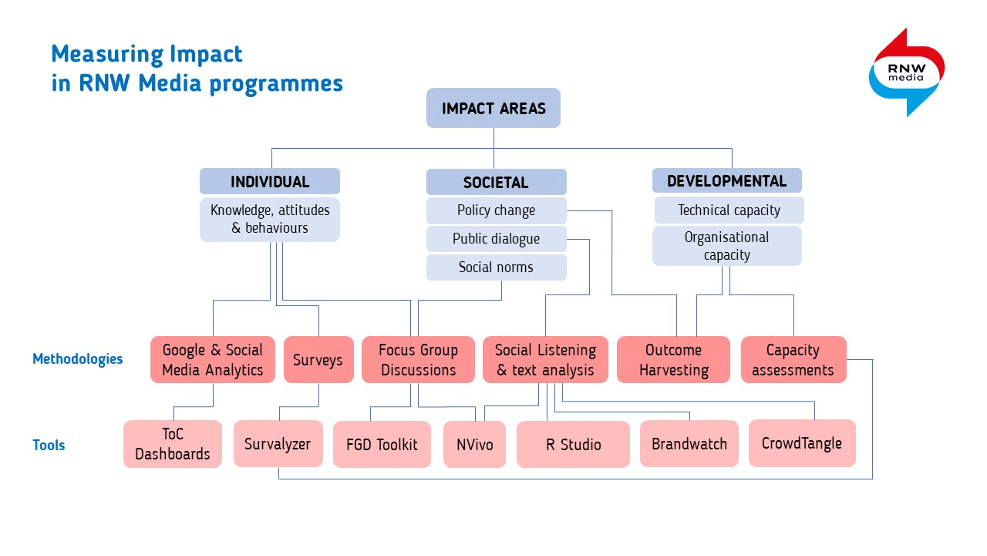
Within RNW Media programmes, we distinguish between three impact areas: individual, societal and developmental.
Baselining
Depending on the strategic objectives of the project, we baseline one or more of the three impact areas: individual, societal and developmental.
- Individual impact: Through our projects and platforms, we are looking to provide people with reliable information and engage with them on topics that they care about. This should lead to an increase in awareness and knowledge about relevant topics, or changes in attitude towards each other or towards sensitive topics. We measure this by monitoring online engagement with different topics, and by directly reaching out to young people through surveys, focus group discussions and interviews.
- Societal impact: We not only address individual people, but also look to improve public dialogue in societies – especially those taking place online. We can monitor public dialogue, on our own platforms and beyond, through social listening. Secondly, our projects actively engage in advocacy initiatives that aim to improve policies and practices. We measure our achievements in this area through Outcome Harvesting, which looks to establish credible contribution towards observed societal changes. Lastly, our projects challenge restrictive social norms, and we have recently started to develop a measurement approach towards specific norms that are relevant in our contexts.
- Developmental impact: As sustainability is becoming increasingly important in the nongovernmental sector, RNW Media invests in strengthening civil society in more than one way. We continuously strengthen the capacity of our teams in-country, and ultimately support them to become independent organisations. This is measured through our capacity assessments and training surveys. RNTC also plays a vital role in strengthening the capacity of NGOs, journalists and media globally, which is assessed through pre- and post-training surveys.
Baselining impact on individual users
Impact on individual users is focused on improving awareness, knowledge, attitudes and behaviour around relevant themes of the RNW Media programmes. Often, focus group discussions (FGDs) are used in the inception phase of a project to determine relevant knowledge, attitudes and behaviour among young people, which feed into our intervention design.
However, we do not recommend baselining knowledge, attitude and behaviour for the purpose of comparing this data to mid-term and end-term evaluation data. Our past experiences have shown that the lack of specificity in topics and themes at the start of a programme makes it difficult, if not impossible, to establish change over time in relation to the programme’s influence.
Instead, we recommend the following:
- Conduct a baseline and end-line measurement in relation to specific campaigns that are implemented during the programme. Campaigns have targeted topics and messages that can be measured and compared in a simple way with social media analytics, social listening and surveys.
- Keep track of self-reported change through the open-ended survey questions that we conduct on an annual basis. These questions can be integrated in different project surveys.
Baselining impact on societal level
Impact on societal level revolved around policy change, public dialogue and social norms. Each of these require different ways of baselining:
- Policy change is baselined as part of the context analysis in the inception phase. Mapping out relevant (inter)national policies and legislation in relation to the programmatic themes provides insight in needs and opportunities for influencing policy areas.
- Public dialogue is baselined through social listening, centred around who talks about what in open online spaces (like Twitter). Social listening is most effective when linked to specific campaigns that can be tracked.
- Social norms have been a recent addition to our impact areas, and we are still in the process of developing a way to measure this effectively. Please consult the PMEL team for more information on how to baseline and track our influence on social norms.
Baselining impact on developing capacity of civil society
We are currently strengthening civil society in two ways: we develop the capacity of our country teams with the aim of becoming independent organisations in due course, and through RNTC we train journalists, activists and NGOs to use media more effectively in their respective societies. These two approaches require two different baselines:
- Capacity (needs) assessments are conducted among our teams to inform capacity development planning and serve as a baseline for a team’s capacity measurement. Capacity development is tracked in four areas: technical/digital, media, thematic content, and general/organisational.
- Training assessments are conducted by RNTC for all individual training participants. Rather than baselining their knowledge and skill levels before the start of a training, retrospective pre-post testing is used after the training.