
The 12 Steps to Build an Advocacy Strategy
What are the 12 steps to build an advocacy strategy?

Go to Assignment 9.5: Sequencing the steps
Advocacy strategy steps
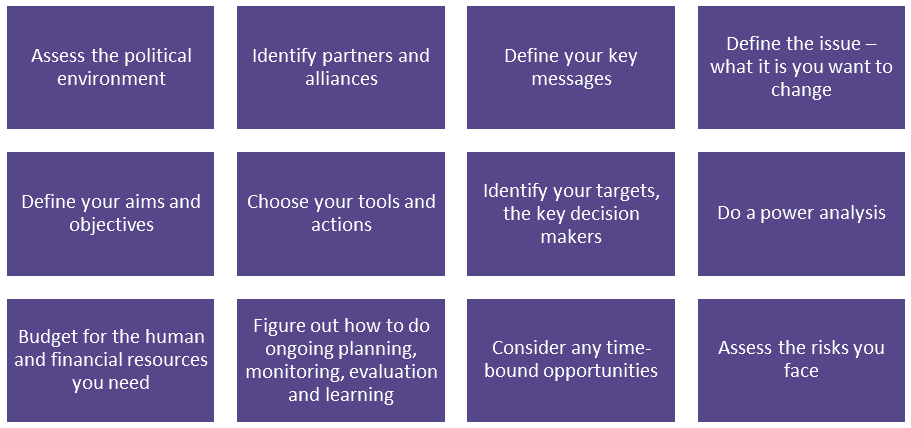
In the previous assignment, you have ordered the steps of an advocacy strategy. At RNW Media, the suggested order of activities is as follows:
Step | Key questions to answer |
1. Define the issue – what it is you want to change | What is the issue you want to address? How does it affect (young) people? Why does this issue exist, and what is preventing change? |
2. Define your aims and objectives | What is the long-term result you are hoping to achieve? This is your aim. What are the short-term results you want to achieve? These are your objectives. |
3. Assess the political environment | What are the opportunities for advocacy, for influencing policy? What are the risks? How does your political context affect your aims and objectives? |
4. Do a power analysis | Who is involved in this issue? Who does it affect? Who has interest in dealing with the issue (your allies), and who wants to block change (your opponents)? |
5. Identify partners and alliances | Who can you work with to achieve the change we seek? Which organisations have the capacity and interest to address this issue, and see the issue and potential solutions in the same way as you do? |
6. Identify your targets, the key decision makers | Who are the decision makers who need to act if you want to achieve your objectives? Who are the key people in these organisations? These are your direct targets e.g. individuals in companies or government departments. If you cannot influence them, who can you reach who can influence the direct targets? These are your indirect targets e.g. suppliers to a company, or a donor which funds the government department. Note: these targets should not be confused with the ‘target groups’ (the beneficiaries) of development work. |
As of step 7 you are working on building your action plan: 7. Define your key messages | What are the key messages you want your targets to receive, and which you will keep repeating in all your communications? How can you make your point in one-minute? Can you present a win-win message, where the decision-maker also stands to gain from your proposals? |
8. Choose your tools and actions | What tactic or combination of activities will give you maximum influence? Lobbing, advising, media, mobilising the public….? Do you need to begin with some activities and then move on to others? |
9. Consider any time-bound opportunities | Are there any events, significant dates or government decisions which might be important to you? How can you use these opportunities? Can you create opportunities through creating your own event? |
10. Budget for the human and financial resources you need | Who is going to do this advocacy work? Who else needs to be involved? How will their time and other costs be funded? |
11. Assess the risks you face | What or who might stop you from achieving your objectives? Does this advocacy bring risk to you, or to your allies or partners? How can those risks be reduced or managed? |
12. Figure out how to do ongoing planning, monitoring, evaluation and learning | When you implement this plan, how will you monitor what you do, and assess if you are making progress? How can you stay flexible, to adjust your plan as needed, or to respond to a change in the political context? |
Now that you have seen the order of steps suggested by RNW Media, compare it to how you sequenced the steps in your assignment? Is the order of steps similar?
Tips!
- In the sequencing assignment, “Choose your tools and actions” and “Define your key messages” are often placed earlier in the order. People often put it before “Identify your targets, the key decision makers” and before “Identify partners and alliances”. In general, “Identify partners and alliances” are placed more near the end, while it is very important for ownership to strategise together around targets, messages, and tools, versus bringing allies in when most is decided already.
- Keep in mind: Advocacy is never a linear process of step 1 to step 12. As it is a long term process you might have to revise certain steps along the way, as e.g. your power analysis indicates other targets than you had defined in your objectives or getting your issue on the agenda is harder as expected, so you need to adjust your messaging.
Go to Assignment 9.6: Reflect on an advocacy campaign (optional)