
Advocacy
In the following chapters you will get introduced to advocacy and the difference to “Behaviour Change Communication (BCC)”and “Information Education and Communication (IEC)”.
What is advocacy?
There is no single definition of advocacy. There are many different definitions of advocacy, for example:


Go to Assignment 9.1: What is your definition of advocacy?
Although there is no single definition, in order to work together on advocacy, it is important to agree on a working definition, in order to have the same interpretation when we talk about advocacy.
RNW Media has chosen the following definition for advocacy:
| RNW Media’s advocacy definition: A set of targeted actions directed at decision-makers in support of a specific policy issue. RNW Media has chosen this definition, as it is simple and to the point and it points out the following essential elements: · ‘Targeted actions’, so there is a strategy. · ‘Directed at a decision maker’, so there is a clear target. · ‘Specific policy issue’, so there is a clear objective. |
As indicated in the definition, RNW Media, and many other NGOs, tend to focus on policies instead of laws in their advocacy work.
Policies (which are principles by which authorities are guided) are more flexible than laws and more easily changed. Laws allow, forbid, or oblige, while policy guides. Therefore, most of RNW Media’s advocacy will be around creating new policies, changing existing policies, or get existing policies implemented. It can take place at different levels, such as local, national and regional, and is aimed at positive change for large groups of people.
Why is advocacy important for the work of RNW Media?
Advocacy is important because it addresses the root causes of problems (it affects systems), leading to longer-term, more sustainable benefits for young people and their communities.
Difference between advocacy, BCC and IEC
You might have come across the terms “Behaviour Change Communication (BCC)”and ‘’Information Education and Communication (IEC)”. Just like advocacy, BCC and IEC are centred on raising awareness on a particular issue with the intention of creating change.
So, what is the difference between BCC/IEC and advocacy?
Go to Assignment 9.2: BCC/IEC or Advocacy?
The importance of legitimacy in advocacy
Legitimacy is an important element within advocacy, because it indicates how valid the advocacy is, based on logic or justification.
Go to Assignment 9.3: Assessing legitimacy
Were these factors among the ones you identified in your last assignment?
| Factors that provide legitimacy in advocacy: · The advocate has things in common with the people who will benefit from the advocacy change. · The advocate has close connections to the group who will benefit, so knows and understands the issues well. · The advocate provides evidence to support their claim. · The advocate provides proof of support from the group who will benefit. |
Legitimacy in the context of advocacy refers to “who or what gives the organisation the right to interfere”. On whose behalf is the organisation aiming to realise change? In other words: what gives this organisation the authority to do so and why would policy makers and decision makers listen to them?
- That you are representing the voice of a large group of people or
- That you have extensive scientific evidence backing up your claim.

Learning Journal Reflection
Where does RNW Media gets its legitimacy from and how can this be increased?
Advocacy tools and actions
There are different ways of doing advocacy work.
Scale of naughtiness (tools and actions in relation to the openness of the decision maker to your advocacy and the relationship with the decision maker)
Go to Assignment 9.4: The scale of naughtiness – advocacy activities
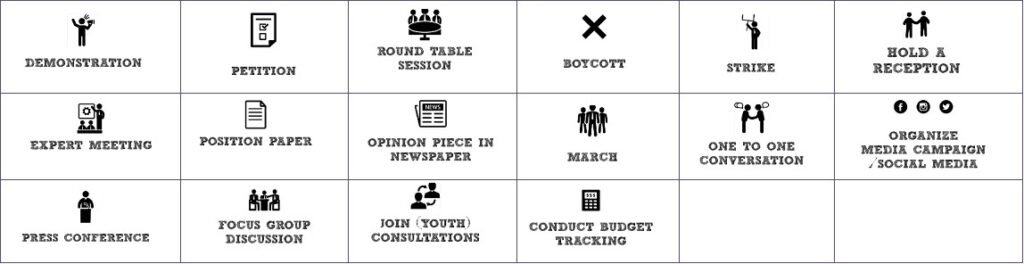
The scale of naughtiness

As shown in the previous assignment, there are very different ways to tackle advocacy work. Different activities fit different situations. For example, public action is confrontational. If you already have a relationship with a policy maker, it is not wise to start with a confrontational activity as it can ruin your relationship. In that case you are more likely to use advising. If the non-confrontational way does not work, you can always shift towards more confrontational ones at a later stage.
Below you find an example of how your scale of naughtiness from assignment 4 could look like. On the left-hand side are non-confrontational tools and actions and towards the right-hand side the more confrontational ones.
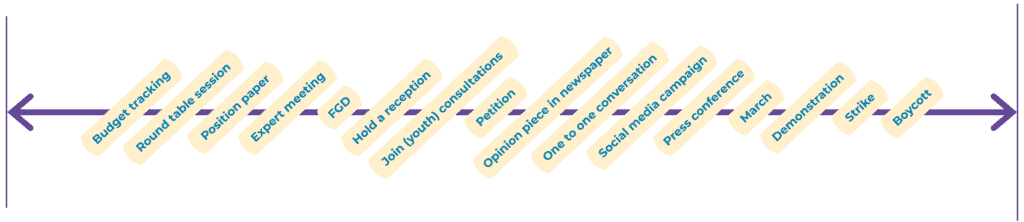
Once you have defined your relationship with the policy maker, you can decide on appropriate tools and actions:
Table: Different advocacy tools and actions for different situations
You and the policy maker do not share a joint interest | You and the policy maker do share a joint interest | |
The policy maker is not in your network | Public action ~ making the policy maker aware of and responsive to the issue through: DemonstrationsPetitionsMedia campaignsAwareness raising – CampaignsLegal processes | Advising ~ process of formal exchange and negotiation involving: ConsultationsExpert meetingsConferencesRound table conversationsResearch presentations |
The policy maker is in your network | Networking ~making contact and building relations through: Drinks, social meetingsPolitical party gatheringsConferencesCoincidental meetings | Lobby ~ informing and influencing policy maker from within an informal relationship through: One-to-one conversationsTelephone consultationsDrinks, social meetingsCoincidental meetings |
Engagement with decision/policy makers is an important factor in developing an advocacy strategy as it determines the methods to use. Engagement refers to the relation an organisation has with decision/policy makers and the position it takes towards these decision/policy makers. It is important to realise that engagement is not static and can change over time and that the used methods will change accordingly.
As shown above, there is a clear link between a policy makers interest in the topic and the method to use, as well as between the relation between the organisation and the policy maker. If there is no relation and the policy maker doesn’t know the topic yet, public action would be the best method to start with, as the aim is to get the issue on the agenda of the policy maker (agenda setting). The organisation starts from its own interest to make it the decision maker’s interest. Once the topic is known the other methods can be used. The ultimate aim is to get a one to one meeting (lobby) with the decision/policymakers, either directly when the topic is known, and the relation is close or indirectly via public actions and/or networking.
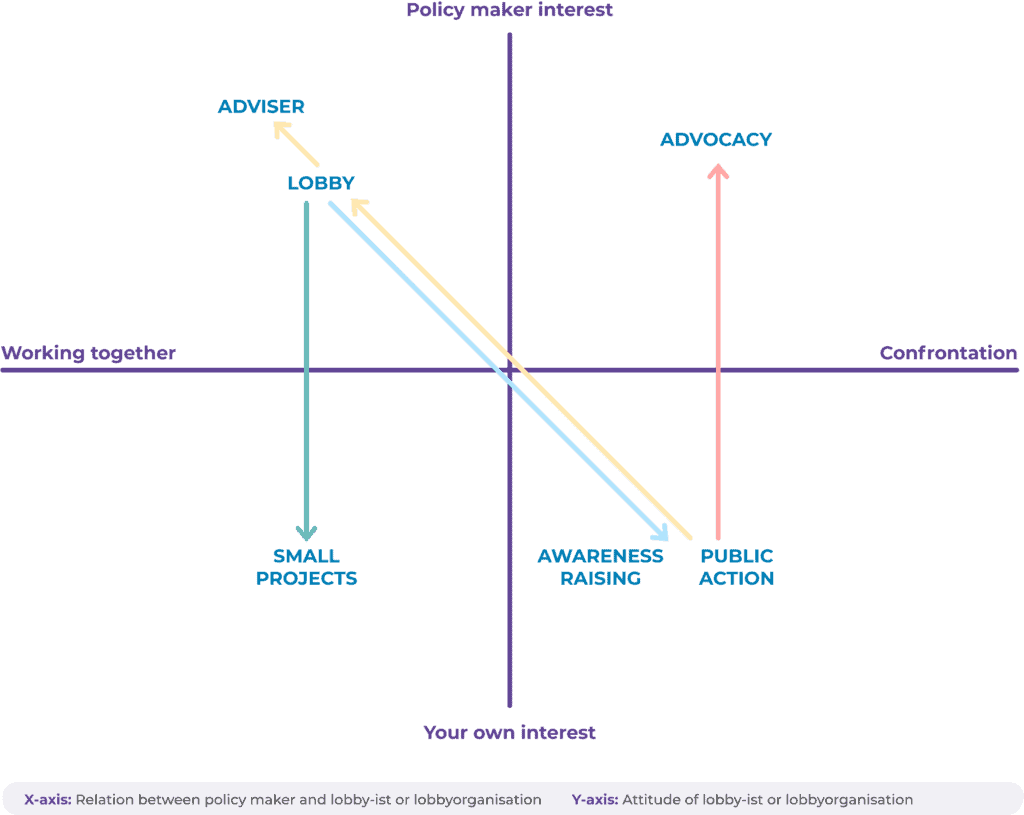
Your target, a policy maker, can also be an ally. Often targets in advocacy are seen as opponents, but you can also lobby and advocate with allies (to make them even stronger allies or have them turn opponents into allies).