Step 6: Map change pathways
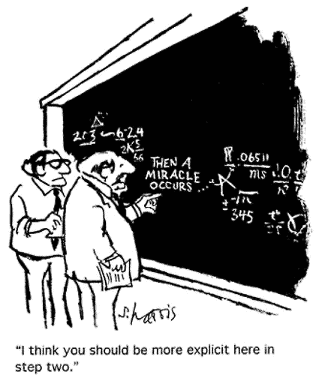
Now you have established what is A and what is B, as well as everything that is relevant with regards to the context and system you are working in, step 5 serves to establish how to get from A to B. Looking at the cartoon, step 6 serves to establish what happens during ‘and then a miracle occurs’. In a ToC, this ‘miracle’ is not a miracle, but this encompasses different pathways of change.
A pathway of change comprises different steps that are needed to get from A to B. Usually, a ToC has different, often interlinked pathways of change, that are all needed to get to go from A to B. Simplified, this looks like this (here pictured with 3 pathways, but there can be more or less):
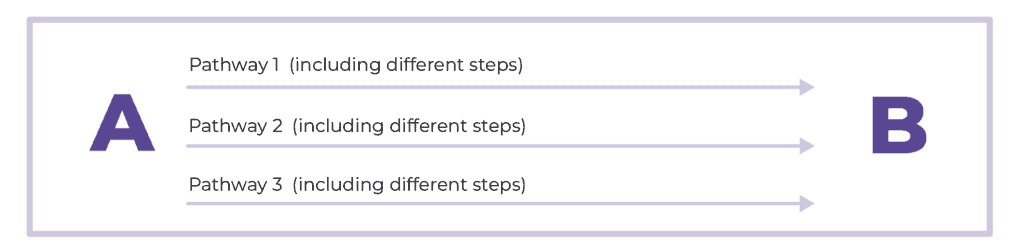
As explained, a ToC starts from the premise of a complex social reality – which is why one linear pathway is not enough to get from A to B, and which is also why the pathways are interlinked. This links to step 3, in which multiple dimensions of the context as well as relevant stakeholder and actors were analysed. This serves to inform the what and who needs to change to get from A to B. This will be the basis for designing the different pathways.
Each pathway has different steps. To go from one step to the other, guiding questions are ‘only if’ (going back from B to A) or ‘so, that’ (going forward from A to B).
TIP! Each change in a pathway influences others around it in different ways. These linkages are often referred to as ‘causal relations’. Check the flow of your pathway by taking each change and ask two questions:
- Is this change/condition/result necessary for the next one to happen? – If it is not, then the change can be removed.
- Is this change/condition/result sufficient for the next one to happen?– If it is not, then consider what additional changes and conditions are required to create sufficient change.
Simplified Example: Based on the situation analysis done in step 3, different pathways that contribute towards a reduction of child marriage in Country X can be mapped out. These can include (among others): a change in social norms regarding gender inequality and child marriage, an increase in economic options for girls, a change in laws related to child marriage on the national and local level. The pathways are interrelated, for example, changed laws can affect social norms, as well as the other way around.
Assumptions underlying the ToC
Every ToC has assumptions: they connect the different steps of the pathways to each other, and are therefore what holds a ToC together. Assumptions guide the cause-and-effect relations that were drawn in the different pathways – so it is really important to question them. In many cases, the assumptions are based on evidence and research. The assumptions guiding a ToC are usually written down in a narrative accompanying the visual version of the ToC. In some ToCs, the assumptions are included in the visual – an example is the ToC of the Get Up Speak Out program (ToC 1 in Annex 2).
Assumptions are also made about the different actors and stakeholders: in mapping actors and stakeholders involved, you usually assume they have a certain role and interest. It is important to think this through, and how this affects different steps in the programme. Example: In the programme for child marriage, it is an assumption that different social norms regarding child marriage (child marriage being less acceptable in society) will lead to a decrease in child marriages in country X (assumption related to the pathway on changing social norms). In addition, it is assumed that local leaders will (at least at the start) be resistant towards any change related to the social norms on child marriage, since they think it is important to uphold traditions (assumptions related to the interests of stakeholders). Note that, while these are called assumptions, they can in this case be based on evidence, for example on the relation between social norms and child marriage, and on a study capturing views of local leaders on traditions.
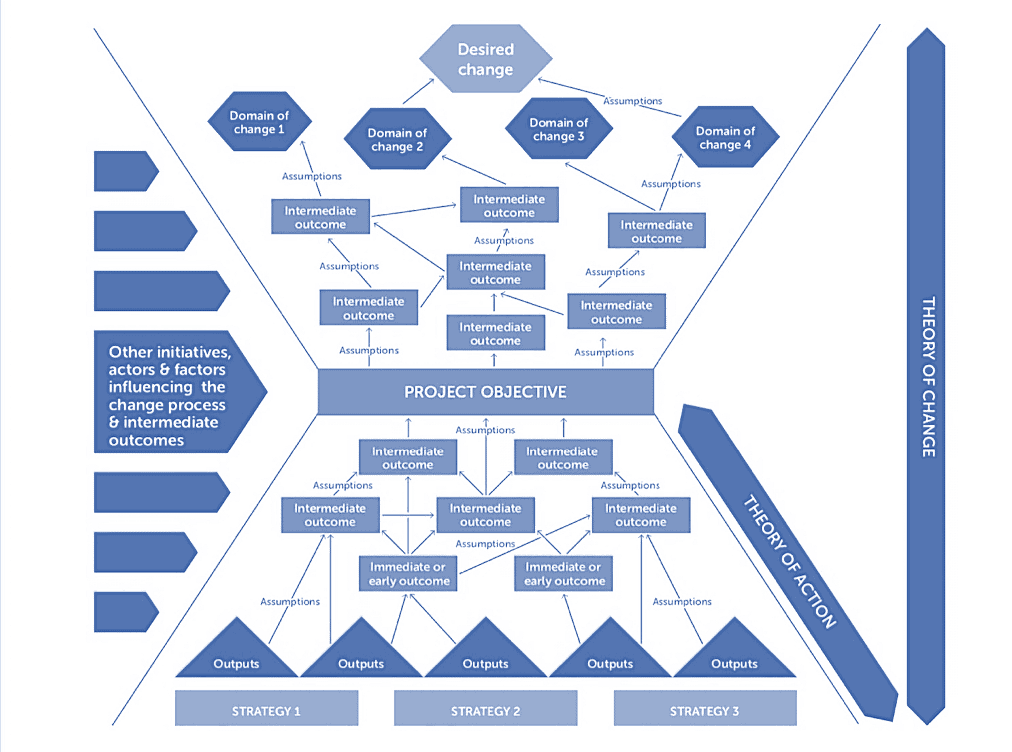
As you can see from the visual, assumptions can link to different steps in the pathways. You have established what you want to do and why you are doing it, and you have made the most important strategic decisions on who is responsible for doing what (if working with multiple organisations) and the capacity of your own organisation.
Now, it is time to get more concrete and to start thinking about actual activities that will feed into the pathways of change you developed. You are normally working per pathway in this step. You start developing a rough draft of an activity plan, also thinking about the logical order of the activities.
In addition, you can start thinking about ‘cross-cutting strategies’. Cross-cutting strategies sometimes also referred to as ‘core principles’ (or something similar), are values or strategies that people/you believe to be of utmost importance to be upheld and that can therefore be seen as guiding and are integrated into all pathways of change.