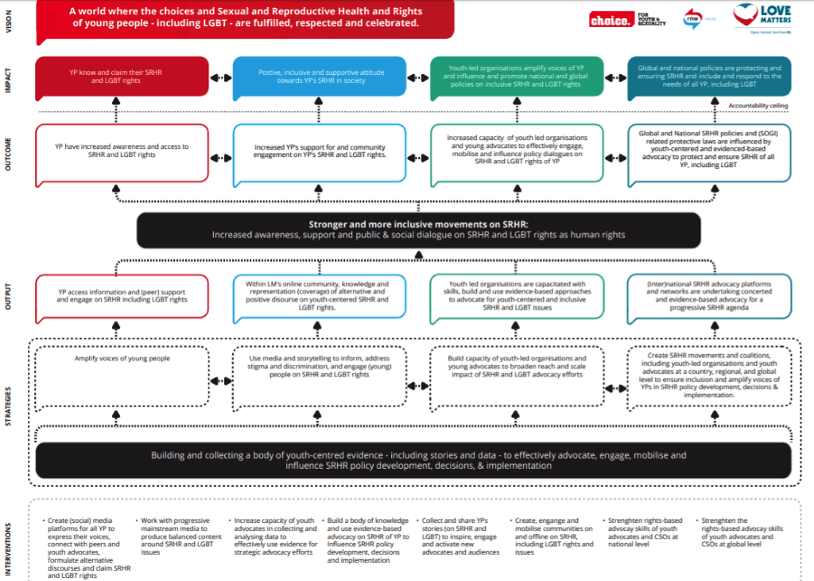
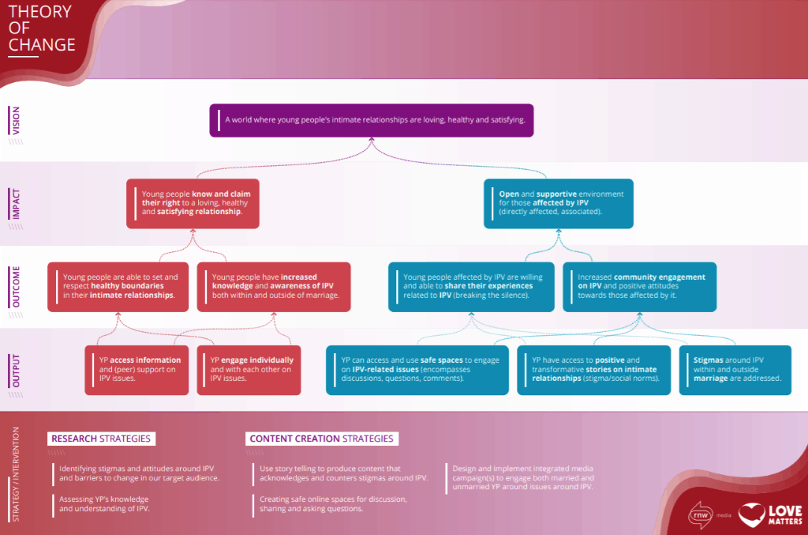
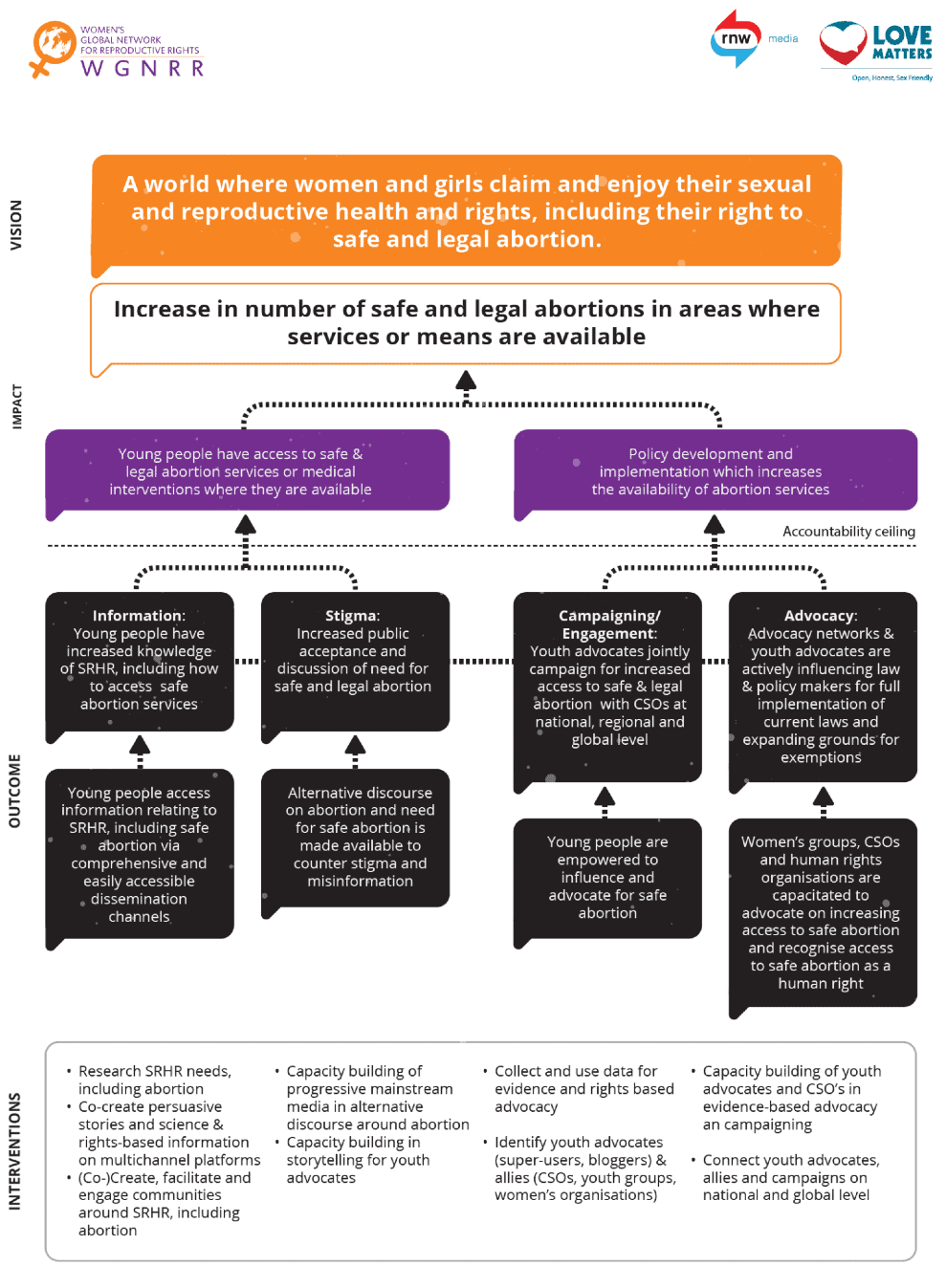
The ToC Product

The ToC product is the outcome of a ToC process and represents the theory of change of an organisation or a project. There is no fixed format; the ToC product can be presented in many forms. Often, it is best captured in a combination of a narrative and one or more diagrams or visualisations of the envisaged change process. A ToC is never a simple story. Text alone can become dense and jargon-filled and does not speak to the imagination. But pictures alone cannot tell the whole story. Visualisations should support the narrative, and vice versa.
Keep in mind that a Theory of Change, or a theory of action, should be ‘a living product’! A ToC is a reflection of the thinking of a specific group of people, at a specific point in time. It remains relevant for a limited period of time and needs regular reflection, review and adaptation to keep its utility.
ToC narrative
The content, length and level of detail of a ToC narrative is linked to its nature and purpose, e.g. a funding proposal, a strategic plan, policy paper, internal or external communication. The presentation varies with different audiences or users and, in the case of a funding proposal, a format may be provided by the donor.
The narrative needs to cover:
- The stakeholder groups involved in the ToC development process;
- The desired change;
- Current situation, describing key actors and factors influencing the envisaged process, including power and gender dynamics;
- Objectives and contribution of the project to the desired change (specify time frame);
- Main strategic choices and rationale;
- Critical assumptions underlying strategic choices and change pathways (cause-effect relations)
- Explanation of the diagram or visualisation (if any);
- Monitoring, evaluation and learning process;
- Description of the use of the ToC during implementation.
Depending on the purpose and use of the ToC product, other components could be:
- Risk analysis and mitigation measures related to the critical assumptions;
- Log frame (if required);
- Learning or research agenda.
Elements of good ToC narratives: tips and tricks
- It should be concise
A ToC narrative should support the ToC model and is usually captured in one page. We would recommend writing a narrative in 1 A4.- It should be supportive to the model:
The narrative is meant to guide the reader through the model. This means that the narrative ideally should not contain any new/additional information that is not part of the model.
- It should be supportive to the model:
- It should guide the reader through the model
- Guiding the reader through the model can be done by explaining the assumptions in the model (often indicated in the ToC with an arrow). Therefore, the narrative should:
- clarify why one activity leads to an effect;
- clarify why one (short-term) effect might lead to another (long-term) effect;
- clarify why the long-term effect is likely to result in your ultimate impact goal. N.B. Depending on your audience, the level of rigor of the clarifications of assumptions can differ. It can be done by just explaining the logic or the logic can be supported by existing scientific evidence or with results that you have monitored in previous years.
- Guiding the reader through the model can be done by explaining the assumptions in the model (often indicated in the ToC with an arrow). Therefore, the narrative should:
- It should follow the model
- First capture your readers attention by the model, then explain it briefly in the narrative.
How to start
- Start with describing your impact goal
Your impact goal, also sometimes referred to as ‘ultimate outcome’, ‘mission’ or ‘vision’ is the end point of your ToC. Firstly, this will motivate the reader to read further. Secondly, each part of the ToC is essentially a step in a journey towards the end goal. Therefore, knowing the ultimate impact goal is the first step in understanding the logic of the model. One can hear the reader think: ‘Okay, that sounds great! But how?’.
- Concisely describe the activities or interventions
Answering the ‘how question’ starts with describing the activities (since the effects logically follow from the activity). The activities are a prerequisite for the effects to occur.
- Clarify why the activities/intervention lead to the first outcome(s)
RNW example – Snapshot of ToC Citizens Voice:
The ‘creation and (technical) maintenance of a user-friendly platform’ does not necessarily lead to the output: YP from different backgrounds accessing platforms. However, in combination with creating and engaging with offline and community, it does. One cannot expect a reader to understand this directly from the model. This shows precisely the added value of the narrative. Example sentence for narrative: In order to let YP from different backgrounds access the online and offline platforms (output) RNW Media creates and maintains user friendly platforms (both off-and online), and it actively creates and engages with online and offline communities.
- Describe the different ‘routes’ leading to the impact goal and their cohesion
In both ToC’s there are effects following from ‘accessing the platforms’ and there are effects following from the ‘partnerships with media organisations and other partners’. To describe these routes separately from each other, it is recommended to enhance readability. One could consider labelling the two routes A & B. Where the two routes intersect, one could mention the cohesion in the narrative. RNW-example of SRHR ToC: As a result of accessing the platform YP engage with (pluralistic/SRHR) information on platforms, share their views, needs and stories and engage in discussion. These platform activities can also reinforce each other (see grey circle). In the longer term, this can lead to increased knowledge on SRHR, the referral to youth-friendly SRHR service and/or the sharing of evidence on YP views with partners in the media, advocacy or service providers (see route B).
- Describe the different steps in one route
This is part of describing a route, but highlights the assumptions between effects. RNW example of SRHR ToC: As a result of increased knowledge on SRHR, some YP’s have a more positive attitude towards SHRH as well. Knowledge as well as a more positive attitude lead to making more informed decisions about SRHR in their personal lives, which contributes to the ultimate goal: enjoyment of their SRHR’s. In order to better guide the reader through the different steps, one could consider labelling the effects with short term/medium term and long term.
Visualisation of the ToC product
An important function of visualising the ToC product is communicating the ToC to people who were not involved in the process of developing it. This means that it must be understandable and attractive: what message do you wish to convey, which story do you want to tell? Think about the purpose of your visualisation, and who will view or use it. Use more than one visualisation if that helps to convey different aspects of the ToC. Thinking about a good way to visualise the ToC can clarify your thinking further. It forces you to think about what questions outsiders might have and to structure the visualisation so that it focuses on what needs attention.
ToC visualisation often presents a diagram or flow-chart of the pathways of change, in a linear way. The result is a logic model that does not explain key elements. This carries the risk of losing – or at least not using – the diverse and rich information the ToC process provided and of pushing us back into linear thinking.
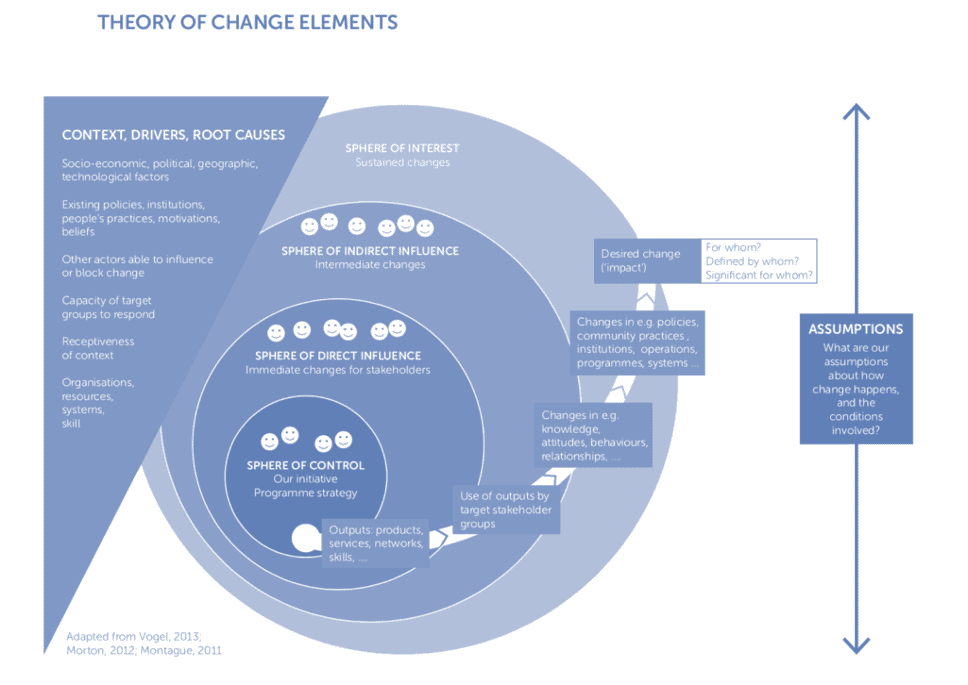
Visualisation has its limits. In practice, it is impossible to integrate all key elements of the ToC analysis or product into one visualisation. Sketches and symbols can be interpreted differently, making it hard for outsiders to understand the image. Visualising the ‘why’ and the ‘how’ of the ToC is difficult. Therefore, visualisations always need to be accompanied by narratives.
Here are some examples: