
Outcome Harvesting Copy
This section is mainly based on these sources: 1 & 2.
Outcome harvesting is a different type of evaluation. While “traditional” forms of evaluation tend to measure if predetermined objectives and outcomes have been achieved, outcome harvesting collects (“harvests”) evidence on what has changed (outcomes) and then works backward to determine if and how a campaign or intervention contributed to these outcomes. Outcomes can be positive or negative, intended or unintended, but the connection between the initiative and the outcomes should be verifiable.
An outcome is defined as:
An observable change in agenda, activity, relationships, policy or practice in another actor to which the programme has contributed – partially or wholly, directly or indirectly, intentionally or not.
When to use outcome harvesting?
Outcome harvesting can be a useful tool for monitoring and evaluation, when:
- The focus is on outcomes and why they happened, rather than on whether activities were carried out as planned.
- In complex situations where the relation between cause and effect are unclear, or and/or where many different actors influence change. This approach can help to understand how individual outcomes contribute to broader system-wide changes (for example in advocacy, campaigning, and policy work).
- For monitoring and evaluation, to learn about the change and understanding why those changes occurred.
Outcome harvesting process
Outcome harvesting is a participatory process that involves the following stakeholders:
- Change agent: Individual or organisation that influences an outcome (organisation implementing the project or programme).
- Social actor: Individual, group, community, organisation, or institution that changes as a result of a change agent intervention.
- Harvest user: The individual(s) who require the findings of an Outcome Harvest to make decisions or take action. This may be one or more people within the change agent organisation or third parties such as a donor.
- Harvester: Person responsible for managing the Outcome Harvest, often an evaluator (external or internal).
Outcome harvesting can be applied by following the 6 steps/guiding principles:
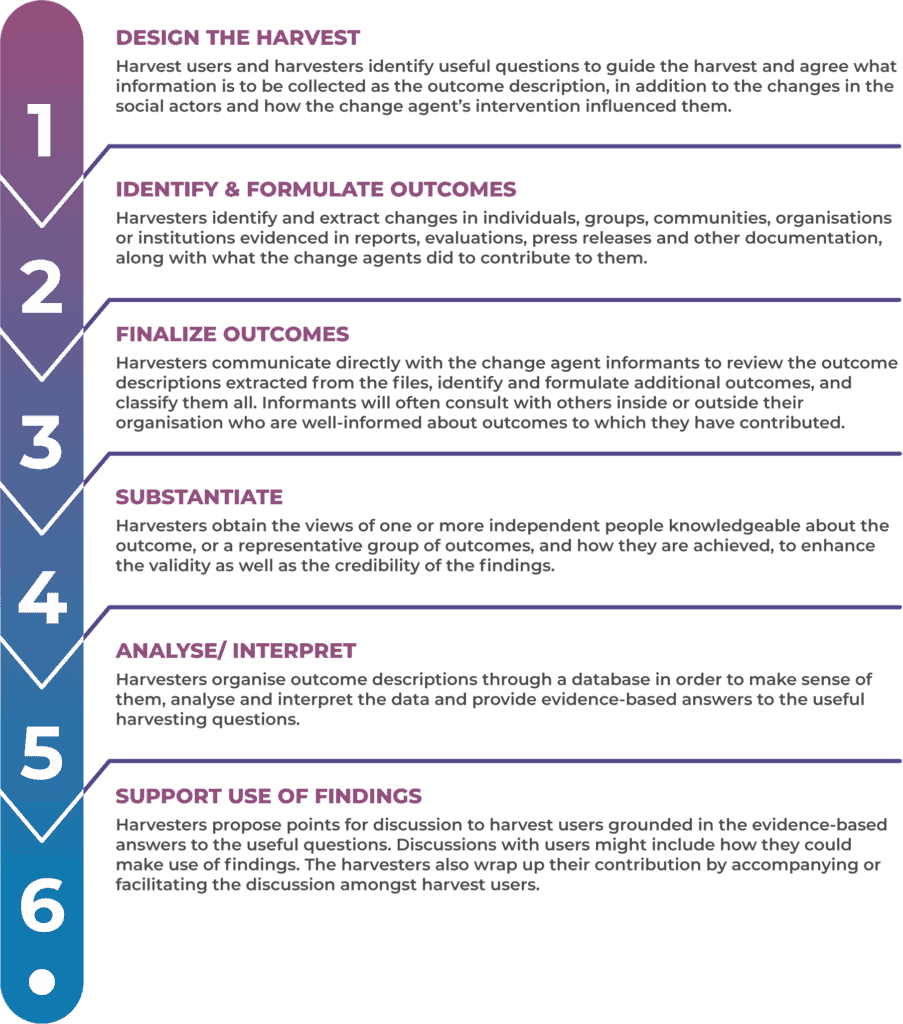
How to identify and formulate outcomes
The step-by-step process detailed below, should lead to the formulation of validated outcome descriptions. The key elements that need to be included in every outcome description are:
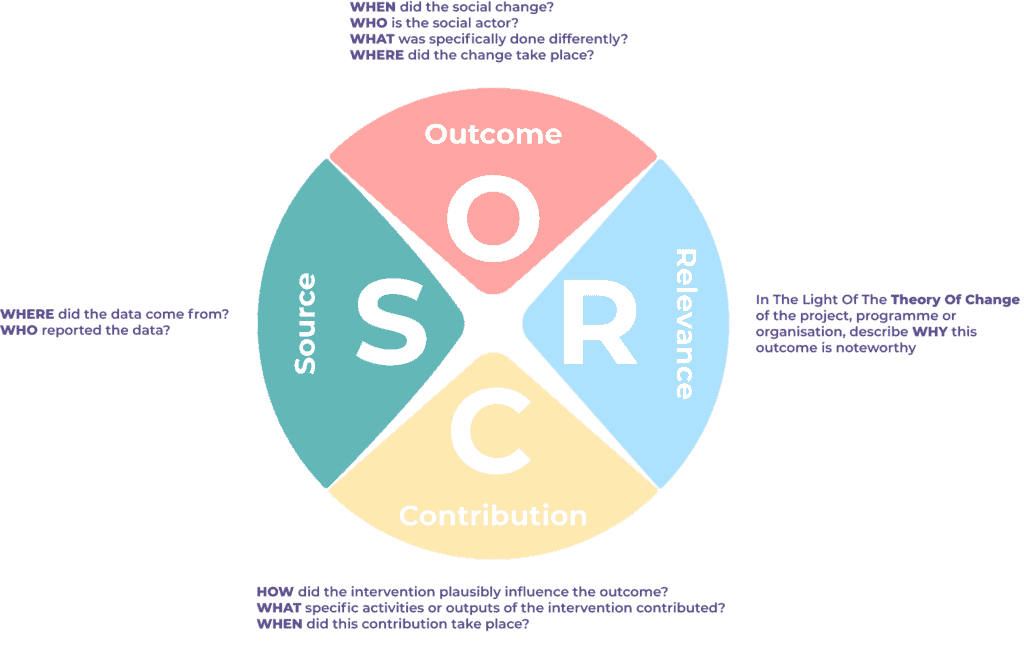
- Outcome description: Who changed what, when and where?
- Relevance/significance: The importance of the outcome in the light of the campaign objectives
- Contribution: What activities and outputs contributed to the change described in the outcome. This contribution can be direct or indirect, small or large, intended or unintended.
- Sources: The specific documents and people who provided the data.
RNW Media and outcome harvesting
As stated in the previous section, outcome harvesting is particularly useful in complex situations that involve multiple social actors, where it is more difficult to understand the direct cause and effect relation, what was achieved and how it happened. Examples of such complex situations include initiatives in the field of campaigning, advocacy and social change processes, which also applies to the field of work of RNW Media programmes.
Before you practice formulating an outcome description yourself, we would like to illustrate how RNW Media has applied this tool, by providing a two examples of outcome descriptions of CV. One example refers to the Habari RDC programme in DRC, where their anti-harassment campaign has triggered awareness and public dialogue on the topic. The second example is about the Justice4Her programme in China, which details how the programme has influenced the new laws on anti-domestic violence.
| Habari RDC – Influencing public dialogue OUTCOME DESCRIPTION Since the launch of the University without Harassment (#UnivSansHarcelement) campaign, awareness on this taboo issue has risen among various actors. Lively on- &offline discussions have been held and it has mobilised students to speak up and debate ways to prevent it. In addition, many victims have started speaking up publicly. SOURCES/SUBSTANTIATION › Quarterly reports: 2019-Q2, 2019-Q3 › Verified by the PMEL team RELEVANCE/SIGNIFICANCE (OF THE CHANGE, CONTEXT) › Sexual harassment is prevalent throughout the country, particularly in the workplace and at universities. Out of the monthly “Face aux jeunes” debates, it appeared that this issue was widespread, but little was being done to address it. › This campaign raised awareness on this issue and provided a space/enabling environment in which young people (incl. victims) feel empowered to speak up, mirroring the #MeToo movement. This is an important way to show how widespread the issue is, putting it at the forefront of public discourse.  CONTRIBUTION DESCRIPTION › Habari RDC, in partnership with Congolese women’s rights organisations SOFEPADI and the youth-led Si Jeunesse Savait rolled out a nation-wide (on & offline) campaign, with activities in Kinshasa, Goma, Mbuji – Mayi, Lubumbashi and Beni. › The campaign aimed to raise awareness among various actors (students, professors, university and national authorities), share the stories of survivors, establish counselling services for students who are targets of harassment, and change the law to make these behaviors illegal. › Online activities included the publication of a series of 21 articles debating issues around harassment and ways to prevent it. The aim was to define the various types of abuse and what makes them possible, through survivor’s testimonies, proposals for solutions and advice for (potential) targets. The articles generated lively discussions with more than 3,200 reactions on Facebook. Visual content was also created with videos and graphics in different formats. The motion design video, Sifa, the harassment survivor, generated 20,000 views. › Offline, the “Face aux jeunes” debates were an opportunity for discussions with more than 240 students from 4 regions of DRC. Testimonies from survivors were collected and measures for their protection and support discussed. › There was a lot of public support for this campaign. For example, OSISA Country Representative who wrote on Twitter: “This is a campaign that deserves sustained attention. Congratulations Habari DRC and Si Jeunesse Savait”. |
| Justice4Her: Policy change OUTCOME DESCRIPTION People’s Congress of Hubei Province adjusted the draft version of the first provincial anti-domestic violence law on 6 points after Qianqian law firm, together with her strategic partner Justice4Her, provided suggestions for improvement on the draft version. The final version of the new law has been approved in the Provincial Congress on 29.03.2019 and is put into practice on 01.06.2019 SOURCES/SUBSTANTIATION › Documentation CV-China on interviews and other › Video Domestic Violence › Standing Committee of the People’s Congress of Hubei Province website page › Quarterly reports: 2018-Q4, 2019-Q1 › QianQian Law firm representatives, pro bono lawyers, police officer Hubei RELEVANCE/SIGNIFICANCE (OF THE CHANGE, CONTEXT) Better protection by law is the strongest form of protection against domestic violence J4H could contribute to. Due to the changes made to the draft version of the anti-domestic violence law, people with no or limited civic capacity and vulnerable groups like elderly, pregnant women and ill patients will be better protected by the law. Also, the need for privacy and confidentiality of victims is explicitly mentioned after the proposal sent by Qianqian law firm and Justice4Her. Approximately 90% of victims of domestic violence in China are female, but the national Chinese anti-domestic violence law has no specific attention to the female victims (Source: Article J4H). Almost a quarter of females in China has suffered domestic violence from their partners in many ways. Estimates show that 94.000 females commit suicide per year due to domestic violence (Source: “Silence Hurt” video). Since there are more than 60 million people living in the Hubei Province, improvement of the law on domestic violence contributes to better legal protection of a huge amount of people.  CONTRIBUTION DESCRIPTION In October 2018, Qianqian Law Firm (Beijing), strategic partner of Justice4Her, provided a training to 44 Chinese pro bono lawyers from various regions of China to raise awareness/update their knowledge on regulation regarding gender-based violence, which was funded by the EU. Just before the training, Hubei Province released a draft version of the “Hubei Province Anti-Domestic Violence Regulations”. Justice4Her and Qianqian Law Firm decided to include a session in their training to discuss the draft of the provincial anti-domestic violence law and elaborate constructive suggestions to revise these regulations. These suggestions were mailed by Qianqian Law Firm to the People’s Congress. The People’s Congress replied to Qianqian, thanking them for the professional suggestions, which they think deserved their serious consideration during the process of formulating the first provincial law on domestic violence. In March 2019, the new law was approved in the Provincial congress and some suggestions made by Qianqian and Justice4Her have been copy pasted into the new regulation, including: “Minors, the elderly, the disabled, pregnant and lactating women, and seriously ill patients who suffer from domestic violence should be given special protection and priority services”. Other suggestions were not literally taken over, but the core message of the suggestion has still been included. |
Now that you know what needs to be included in an outcome statement, and you have seen some examples, it is time to develop some outcome statements yourself.

Go to Assignment 11.1: Outcome harvesting: defining an outcome description.