

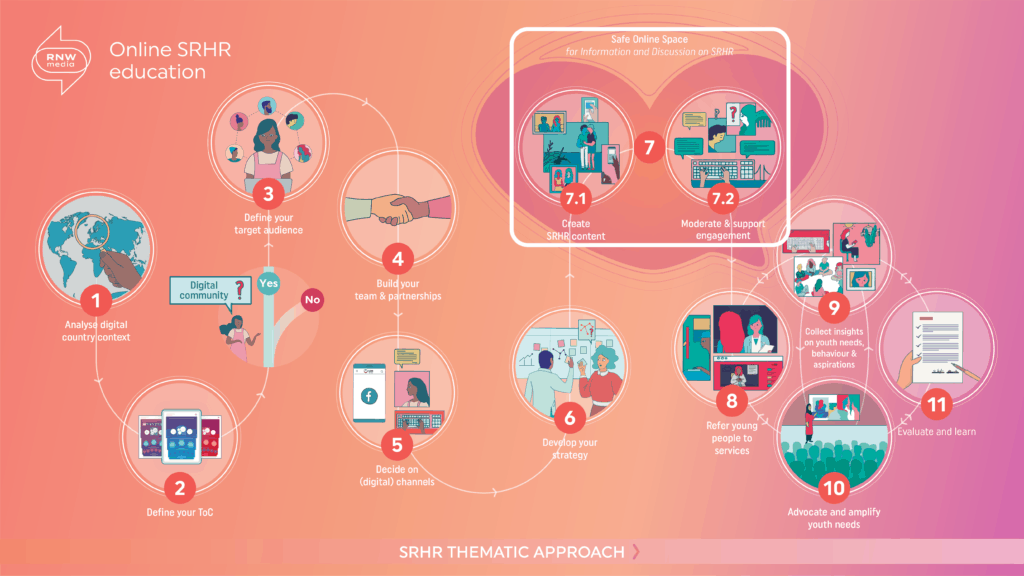
Welcome to the 7th module in the roadmap to building digital communities for social change: the pleasure approach.

Purpose
What sets Love Matters apart is that it talks about pleasure, rather than sticking to the conventional focus on sexual dysfunction and avoiding disease. Love Matters uses the pleasure approach to reach young people with open, honest and pleasure-positive information on love, sex and relationships in places where such information is often censored or taboo.
In this module we will cover what is meant by the pleasure approach, its key elements and why it is important in sexuality education. To illustrate how this approach has been used in the Love Matters programme, some interesting examples are provided, showing how this approach has been contextualised to different settings around the world. The module will conclude with a list of tools and resources that can help you to further explore the pleasure approach and how to incorporate it in your work.

Learning Goals
After completing this module, you will be able to:
- Be aware of the triangular approach to SRHR – incorporating sexual pleasure, within sexual health and rights
- Understand the importance of the pleasure approach in sexuality education
- Identify key elements of the pleasure approach in practice, in both content creation and engagement
- Be aware of how to use the pleasure approach in a culturally contextual manner

Learning Journal Reflection
Before you start, take a moment to reflect: In your context, should sexual pleasure be incorporated in the interventions around sexual and reproductive health and rights (SRHR)? Why?
RNW Media Resources
- LM pleasure promoters @ ICFP 2018
- RNW Media tech paper - sexual pleasure
- Research paper - good sex matters
- Love Matters within SRHR
- Addressing sexual pleasure in restrictive setting - LM Egypt
External Resources
- https://thepleasureproject.org/exercises/
- https://www.gab-shw.org/our-work/training-toolkit/
- Pleasure quiz: https://thepleasureproject.org/wp-content/uploads/2020/04/The-Pleasure-Project-training-toolkit-QUIZ.pdf
- A review of the evidence: sexuality education for young people in digital spaces, UNESCO
- Journals and articles on sexual rights and health
- Organisations
- The Global Advisory Board (GAB) for Sexual Health and Wellbeing
- Pleasure Project
- World Association for Sexual Health (WAS)
- Declaration of Sexual Rights
- Declaration on Sexual Pleasure
- RFSU (the Swedish Association for Sexuality Education) has a wealth of sex-positive resources – comprehensive information, useful diagrams and images – in English and Swedish. RFSU has also produced an engaging sexuality education film for teenagers called Sex on the map (with English or Spanish subtitles). Although not suitable for clients in every context, the resources can develop knowledge and understanding of sexuality, sexual pleasure and sexual response.
- International Planned Parenthood Federation (IPPF)
- IPPF (2008) Sexual Rights, an IPPF Declaration
- Articles
- Gruskin, S., Yadav, V., Castellanos-Usigli, A., Khizanishvili G. and Kismödi (2019) Sexual health, sexual rights and sexual pleasure: meaningfully engaging the perfect triangle, Sexual and Reproductive Health Matters, Volume 27 - Issue 1: Open Issue
- WAS/IPPF/RNW (2017) Fulfil! Guidance document for the implementation of young people’s sexual rights
- Higgins, J. A. and Hirsch J.S. (2008) Pleasure, power, and inequality: incorporating sexuality into research on contraceptive use, American Journal of Public Health 98.10: 1803-1813.
- Philpott, A., Knerr, W. and Boydell, V. (2006) Pleasure and prevention: when good sex is safer sex, Reproductive Health Matters, 14(28), 23-31.
- Philpott, A., Knerr, W. and Maher, D. (2006) Promoting protection and pleasure: amplifying the effectiveness of barriers against sexually transmitted infections and pregnancy, The Lancet, 368(9551), 2028-31.
- The Pleasure Project aims to promote safer sex by focusing on pleasure and desire: providing sex education with the emphasis on ‘sex’, not ‘education’.
- HuffPost Cliteracy increases awareness of the clitoris and women’s pleasure, challenging myths about sex and the female body.