
Video Scripting

What is a script?
A script is a document that details what will happen in the video. Since it is the base of the whole content, this document needs to be clear and finalized before continuing to the next part of the process. How the script is structured depends on the type of video that is created but we have created a guideline that applies to most formats, the most important of them all: KEEP IT SIMPLE!
- Target Audience: it is important to define who are we talking to, this will determine the tone, the message, the format, etc. Take your audience seriously and be as precise as possible.
- Choose the goal of the video (What will this piece of content do?) à intention behind the content, does it want to provoke empathy, awareness, discussion, etc?
- Identify the point of the video: This boils down to a very simple exercise: tell someone why they should watch this video in one sentence. When you start writing your script, put the answer to this question as close to the beginning as possible. Let viewers know what they’re going to get right up front, and you’ll retain more viewers. As a bonus, identifying the point of the video will also tell you what sort of video you need.
- Choose a central character If your video features too many people, it will be difficult to follow and the focus will stray from the main point. Identifying the primary character does two things: It simplifies and focuses your video, and it pushes you toward creating a story.
- Identify your call to action: what do you want viewers to do after watching it?
Scriptwriting
“A script is a typed-out blueprint.”
Meg Swertelow
Good videos start with a plan, an idea, and a framework. That means they start with a script. A video script, whether it’s for a Hollywood film or a short promotional video, is a guide for everything that goes into the final product. While the dialogue is usually the biggest part of the script, it’s also a guide to the locations, time, and action that happen throughout an entire video. A script guides nearly everyone involved with the project, from initial work to post-production, and a great video script writer will keep every step of production in mind throughout the process, from the first draft to the shooting script, which we will study more in a moment.
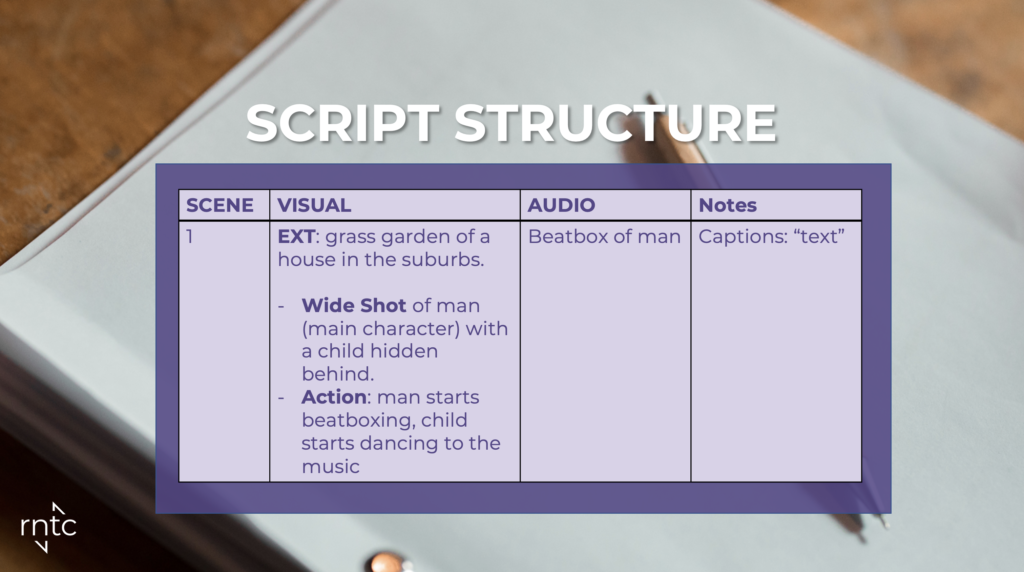
In general, scripts follow a similar structure, and using it will help you in collaborating with other people during the production of your video, let’s go over this structure quickly: scenes, sluglines, action lines, visuals, and dialogue
- Scenes: a scene is a sequence of actions that mark a section of our story, they help us think about our story in action terms
- Sluglines: are brief descriptions of the time and place where a scene occurs. They come at the beginning of a scene and tell the reader whether the action takes place in an interior or exterior, the specific locale of the scene (such as on a street, in a restaurant, in a studio, etc.), and whether it’s day or night. You will often see them as (INT: for interior / EXT: for exterior)
- Action lines: Action lines show what is happening in the scene, and what the characters are doing at the beginning of the scene and provide the director and others an idea of what the initial shot should look like. For instance, if a video opened on a host in a studio, the action could be: Open on the studio with the host already at their desk. The materials for a product demo are visible on one side of the screen, on a separate table.
- Dialogue: Dialogue is usually the bulk of a script. It includes not only words spoken by someone on camera, but also voiceovers and on-screen text like bullet points or chyrons, i.e., captions on the bottom of the screen. The names of speakers are usually centered in scripts so that directors and other stakeholders can immediately identify who is talking.
Shooting script
A shooting script is a key piece in the production of a motion picture. It’s a version of a screenplay that includes detailed cinematography instructions laid out in the order that they’ll be needed, such as certain camera shots, props, and locations. A shooting script is like a combination of a screenplay and a shot list. While a normal script or screenplay follows the narrative of the film, a shooting script is a whole new document adjusted to serve the needs of the production team throughout principal photography. It’s organized to follow the shooting schedule rather than the chronological story. For logistical and budgetary reasons, you’ll want to film certain scenes together even if they’re out of sync with the order of the narrative. And a shooting script provides the plan for exactly what to shoot and when.
Steps in creating a shooting script
- Storyboard it: Create storyboards of the screenplay to help establish a visual style for your project.
- Make a shot list: The director and cinematographer go through the screenplay and create a detailed list of every shot necessary for the production. The production director or AD (assistant director) decides the shooting order for everything.
- Add every detail: Once a shot plan is created, everyone on your team, including the production designer, prop master, and costume designer, goes through the shooting script to make sure every piece of information needed to capture each shot is included. For more info on shot lists visit: https://www.adobe.com/creativecloud/video/discover/shot-list.html
Details to include in your shooting script:
Formatting is ultimately up to you and depends on what works best for your team.. If you use screenwriting software, it may have a shooting script template you can use. Most likely, you’ll want to create a spreadsheet-style layout with a header row that labels each column of information. The information you include depends on the needs of your team but may include the following:
- Scene numbers: These are important to ensure every scene gets covered and will come in especially handy when editing starts. To break down smaller scenes within a scene, use the alphabet (e.g., Scene 1a, 1b, 1c, etc.).
- Camera shots: Include how many and which camera angles to use in each scene, what types of shots are needed (close-ups, medium shots, over-the-shoulder shots, POV shots, etc.), and any special information needed for those shots, such as lighting directions
- What to film: Describe what’s to be shown in each shot, including the character names, what actions will occur, what objects or B-roll should be captured in each setting and any desired acting notes
- Sets and props: Name the location for each shot, list any special props or set decor involved, and make note of key costuming details.
- Special effects and stunts: Describe any stunts, special effects, or transitions that will occur during the filming or editing (fade-ins, cross dissolves, abrupt changes where you’ll cut to the next scene, etc.) and any special considerations needed to allow them to happen.
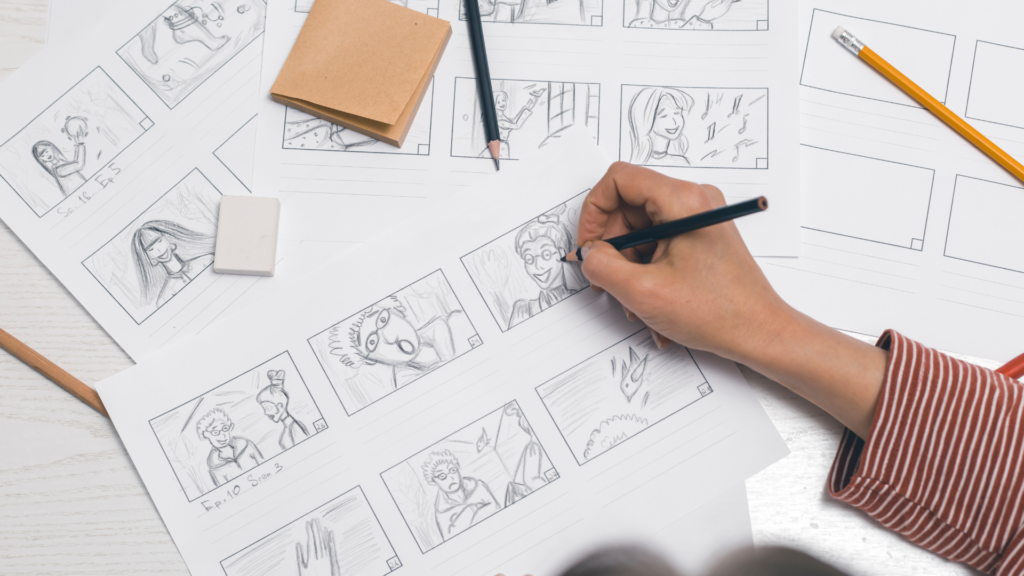
Storyboard
A storyboard is a graphic organizer that consists of illustrations or images displayed in sequence for the purpose of pre-visualizing a motion picture, animation, or video sequence.
As always, there are tons of templates of storyboards to use. We recommend using Canva as it is a good program with loads of free resources to use. We recommend you explore different templates and select the one that works best for you.
You might be thinking this is a lot of information and we still haven’t learned how to shoot a video! No worries, all in good time. For now, we wanted to prepare you the best we can in the planning stage of video production so that this knowledge is in the back of your mind when recording and editing.