
Journalism & Media Models Copy
“Democracy requires citizens to see things from one another’s point of view, but instead we’re more and more enclosed in our own bubbles. Democracy requires a reliance on shared facts; instead we’re being offered parallel but separate universes.”
— ELI PARISER, THE FILTER BUBBLE: WHAT THE INTERNET IS HIDING FROM YOU
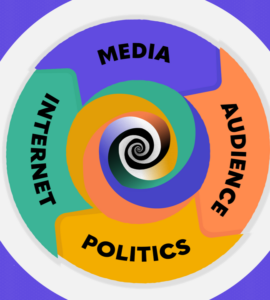
The MAPI spiral on the left refers to “Media, audience, politics and the internet”, which are all interlinked in a democratic feedback loop which creates a downward spiral of polarisation.
How Can We Fix the Media?
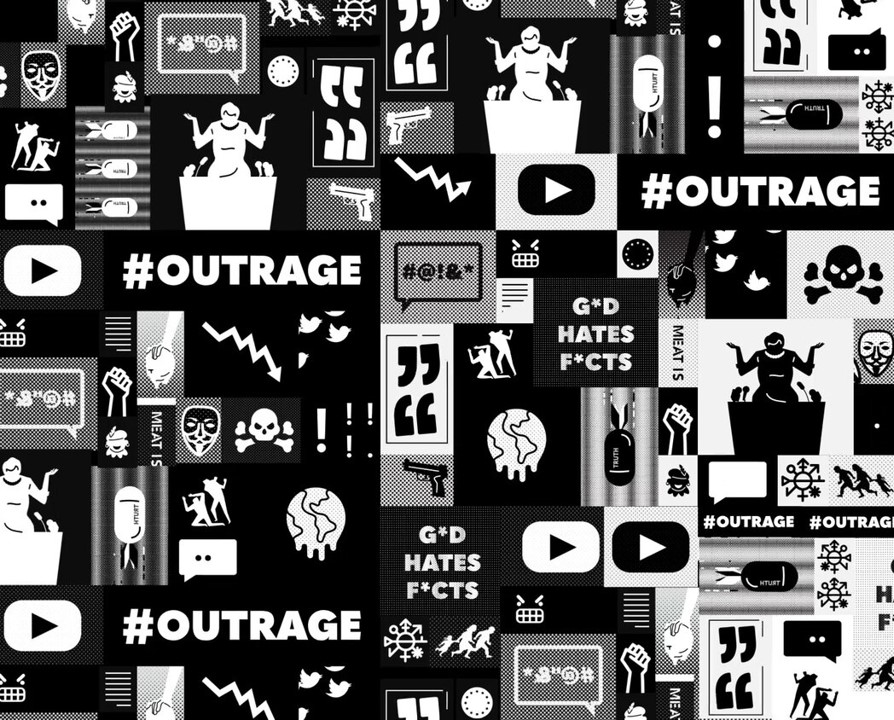
The media has a major influence on the way we perceive the world. The media need stories that sell — and nothing seems to sell better than outrage. They’re always looking to trigger polarised groups when they share harsh headlines with us-versus-them narratives.
They also give a lot of attention to the most extreme and triggering events and opinions. When these kinds of methods keep resulting in higher engagement rates they are just incentivised to do it more often. This is getting worse in recent years, the media is pressured to keep up with the new reality we live in in order to maintain their revenue.
What Can the Audiences Do?
The media might be the ones initially spreading polarised narratives, but without the reader, and the audience, media platforms would have little standing. This pillar showcases polarising tendencies on a much more personal level. Humans like to consume sensational stories that have a lot of emotion. This can be quite tricky to keep in check when media outlets use misleading headlines as clickbait.
We also have a fundamental need to be part of a group, so we often choose to accept information that reinforces our pre established biases and disregard any that give us discomfort. This has been a big factor behind the success of dis and misinformation. So its up to us, the audience, to check our biases and to question information that is given to us, before we start spreading it further.

What Can Politicians Do?
Politicians want to be elected and achieve their political goals, so the biggest incentive for them to push for polarisation is electoral gains. Politicians tend to go through the media in order to reach their audience.
Politicians are role models, whether they realise it or not. They can start trends and often legitimise radical behaviour. For example, did former US President Donald Trump actively call for an attack on the capital, the way he described Covid led to an increase in anti-Asian stigmas, and fatalities because of this.
Polarisation can also stimulate a culture of hyper-partisanship in political parties. Loyalty to the political leaders becomes more important than party principles and scrutiny, again, seen in how it was impossible to impeach Trump as the Republicans refused to vote against him.
We also have a fundamental need to be part of a group, so we often choose to accept information that reinforces our pre established biases and disregard any that give us discomfort. This has been a big factor behind the success of dis- and misinformation. So its up to us, the audience, to check our biases and to question information that is given to us, before we start spreading it further.
• Kurdish, immigrated at a young age to Denmark. One of the first women with a minority background to be elected into Danish parliament, faced huge backlash and hate mail. A friend encouraged her to contact the people who sent her hate mail. She thought they would kill her but then thought that she could make them ‘good’, as she had thought she was good and they were bad. When she called the man to set up a meeting, he said to her he had to ask his wife, which surprised her because this made him seem normal. She went to his house, they had the same coffee maker, they got along etc. After this meeting, she set up coffee conversations, known as dialogue coffees, in which she reached out to more of her haters to try and combat polarisation in society and build bridges. She found that polarisation wasn’t coming from the outside, but was coming from us. Her conversations showed her you need to be willing to listen to each other and allow your POV to be challenged.
How Can We Fix the Internet?
What Can Journalists Do?
It’s because of all of the above that verification is crucial: it means countering a false narrative out there that can cause harm.
How Journalism Has Changed
- The media are caught in scoop and rumour strategies; new media re-enforce their agenda-setting capacity. The most affected media formats are those serving “breaking news”.
- Fer-mongering journalism and emotional communication have taken a strong role.
- Rumours are spread and sustained efficiently in the press. For example, on Twitter / X, it takes 2 hours to prove a rumour that is true, but 12-15 hours to do the same for a rumour that is false. And the more followers you have, the more you spread rumours.
“Values in on-line journalism have shifted from the tradition of ‘accuracy, pre-publication verification, balance, impartiality, and gate-keeping’ to ‘immediacy, transparency, partiality and post- publication correction”. (Stephen J. A. Ward, University of Wisconsin-Madison, Center for Journalism Ethics)
This leads to a tension between online and legacy journalism.
Citizen Journalism
Citizen journalism is news reporting that is done by the people instead of professional journalists. This type of journalism can uncover facts not typically revealed by professional journalists because the public uses alternative sources to find information.
Citizen journalism can be delivered to the public via regular news outlets, online news outlets, social media, and video streaming sites such as YouTube.
The benefits of citizen journalism include: Being in the moment, Offering multiple vantage points, Challenging the traditional media, and Showcasing minority perspectives (those who can’t always access the media)
New Media Models
There are organizations that are finding new ways to include the audience in their reporting. This can be provision of financial support, or even inputs into the content.
This type of journalism can engage in ways that some media find hard to achieve.
Examples include Bellingcat and ProPublica.