
Amplification

It is problematic enough when everyday citizens help spread false, malicious, or manipulative information across social media. It is infinitely more problematic when journalists, whose work can reach millions, do the same.
Whitney Phillips, The Oxygen of Amplification
Information needs an audience, and in this day and age, it is quite easy to find an audience on social media. This makes it possible for false information to spread rapidly and widely. Especially on social media, false information can spread quickly mainly due to three reasons:
- Algorithms: social media favours sensationalistic news, promoting it and labeling it with high importance on the platforms.
- Strategic engagement: social media ads can be used to share false information to specific audiences, with organised networks and bots being used to spread the content further. People who are vulnerable to false information are reached easily and used as an amplification mechanism as well.
- Selective exposure: people tend to share stories that are aligned with their pre-existing beliefs and opinions, whether they are factual or not.
Stories with a lot of online engagement tend to be interesting for journalists. As false information tends to be very engaging, the result is that false information also appears in mainstream media. Disinformation travels easily from online spaces to mainstream outlets, generally following the same pathway:
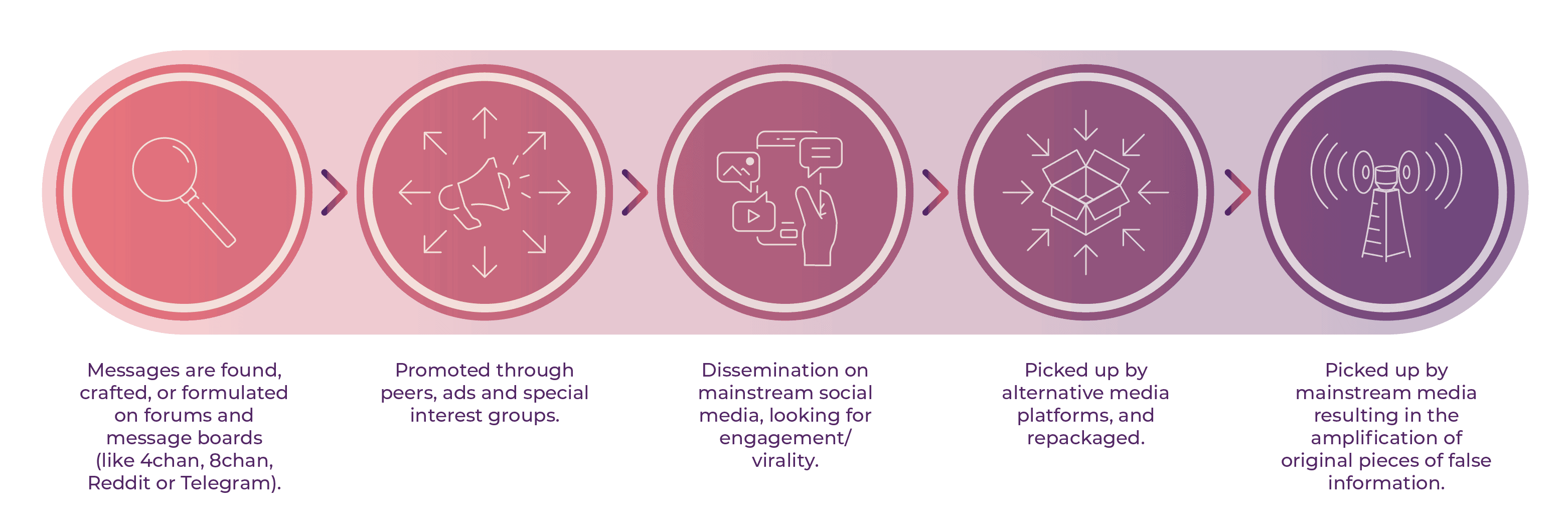
- Messages are found, crafted, or formulated on forums and message boards (like 4chan, 8chan, Reddit, or Telegram).
- Promoted through peers, ads and special interest groups.
- Dissemination on mainstream social media, looking for engagement/virality.
- Picked up by alternative media platforms, and repackaged.
- Picked up by mainstream media resulting in the amplification of original pieces of false information.
Amplification of harmful, polluted, or false information:
- Increases the likelihood, and raises the stakes, of harassment
- Increases the likelihood that similar disinformation and harassment tactics will be used in the future
- Makes particular stories, communities, and bad actors bigger – more visible, more influential – than they would have been otherwise
- Makes it very difficult, if not impossible, not to benefit those looking to manipulate journalists
- Risks normalizing and desensitizing people to harmful views
- Risks lending credence to false narratives
- Relinquishes control of the narrative to bad actors and bad information
- Privileges certain kinds of personalities and information
- Flattens more complicated and contested conversations
Source: Whitney Phillips, Oxygen of Amplification

Amplification checklist
Look up one of your recent articles and check the checklist below. Is there an area where you could improve? If you answer yes for these questions then you might need to improve on your article or reconsider it.
Bear in mind that timing is also important, if a piece of false information already received a lot of engagement, it may have already spiraled out of control. It is also important to understand that you are not being manipulated by disinformation strategies such as the use of clickbait-y headlines to generate more engagement, the use of hyperboles and sensationalistic language, or that bots are being used to push content.