
Introduction to Disinformation Copy

Key Notions
Not all false information can be classified as disinformation. So, it is important to understand the difference between dis-, mis-, and malinformation.
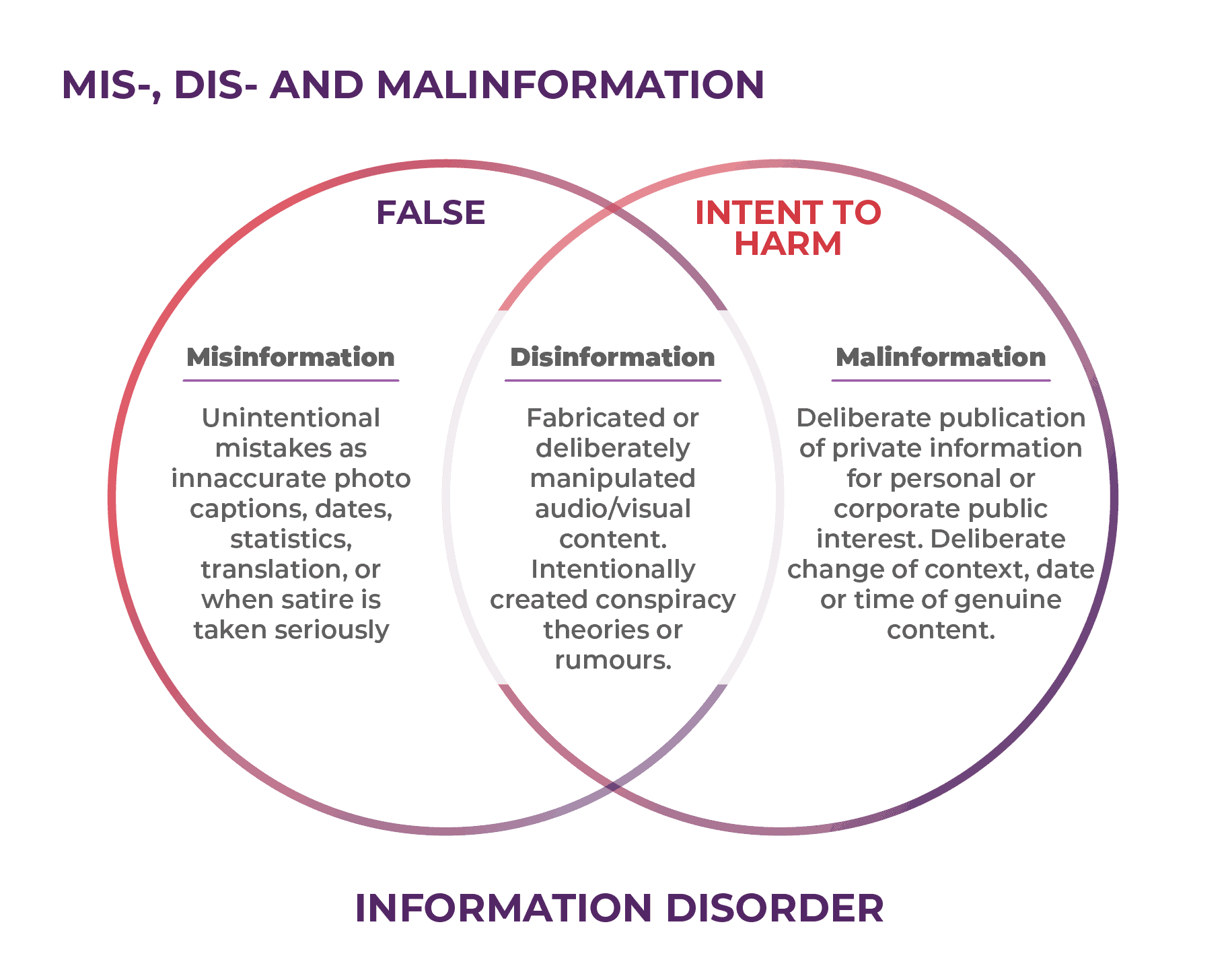
- Disinformation is intended to do harm, it is designed to manipulate. These stories are often entirely made up or use deliberately manipulated content.
- Misinformation is unintentional. It can be a mistake by a journalist, or someone who shares gossip. It can still be harmful, but there is no intent to do harm.
- Malinformation is intended to do harm, but uses factual information. This can be done by exposing someone’s private information or pictures, or by using content out of context.
Definition Quiz
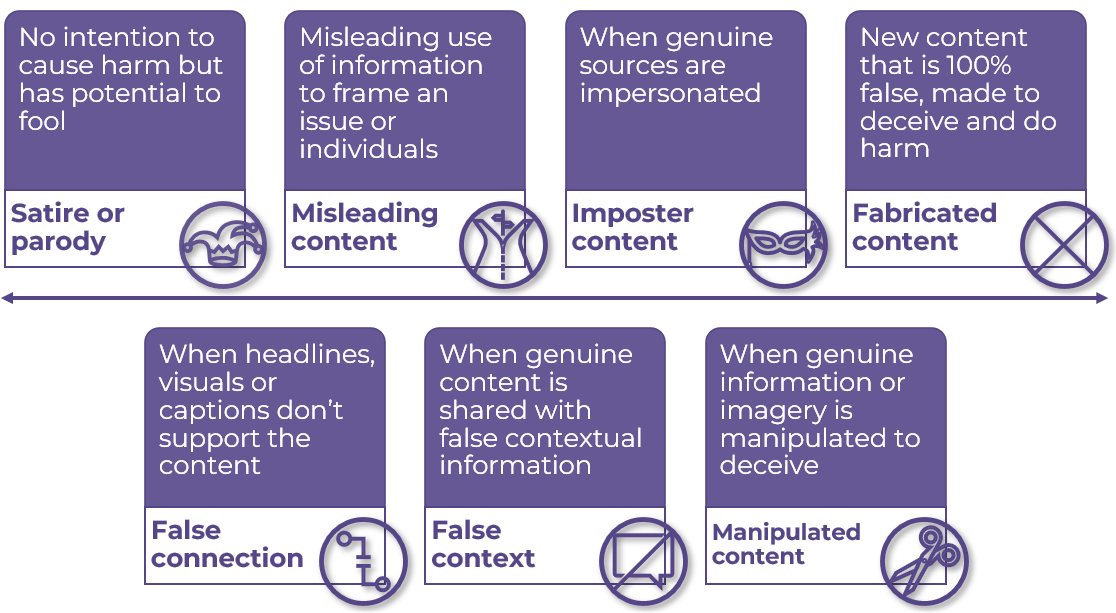
The 7 common forms of information disorder
There are seven distinct types of problematic content that sit within our information ecosystem. They sit on a scale that loosely measures the intent to deceive.
The 8 Ps
Journalists, or individuals, may have different motivations for engaging in the common forms of information disorder that we just discussed. This table shows 8 different types of motivations, the 8 ‘P’s: Poor Journalism, Parody, to Provoke or ‘Punk’, Passion, Partisanship, Profit, Political Influence or Power, and Propaganda. These can be mapped against the forms in order to to see distinct patterns in terms of the types of content created for specific purposes.
Satire or parody | Misleading content | Imposter content | Fabricated content | False connection | False context | Manipulated content | |
|---|---|---|---|---|---|---|---|
Poor journalism | X | X | X | ||||
To parody | X | X | X | ||||
To provoke or to “punk” | X | X | X | ||||
Passion | X | ||||||
Partisanship | X | X | |||||
Profit | X | X | X | ||||
Political influence | X | X | X | X | |||
Propaganda | X | X | X | X | X |