Learning Copy
Organisational learning requires continuous assessment of organisational performance, looking at successes and failures, ensuring that learning takes place to support continuous improvement.
At RNW Media learning across the organization takes place through different events:
- Quarterly review meetings by management team and programme implementation teams to review quarterly results and plan for improvement if needed
- Annual Theory of Change review, by the programme implementation teams to review the ToC and plan for improvements if needed
- Organisational strategy reviews
- Annual planning, making use of the midterm evaluation results and recommendations
- Cross- Learning sessions, held on a monthly basis across regions, where experiences are shared across country teams on diverse topics
- Week of International Learning, gathering team members across countries in one location to exchange experiences and learn from each other as well as external experts
- Summits: events focussed on a specific area of expertise
- Training and workshops: thematic workshops, where knowledge and skills are shared across the organisation
Although learning should happen throughout the project life cycle, it can help to plan for these moments at key evaluation moments or milestones. For example, after and evaluation (mid or end term), you can make a habit out of planning a feedback/learning session to jointly reflect on the report, see if people recognise the results, if there are things that surprised them and what lessons they would like to take to a next project. A learning session can also be planned to collect feedback on the process, with or without external partners.
There are many tools available that can help you to conduct such an evaluation session. One of those is an “after action review session”, which can help you to identify and record lessons learned.
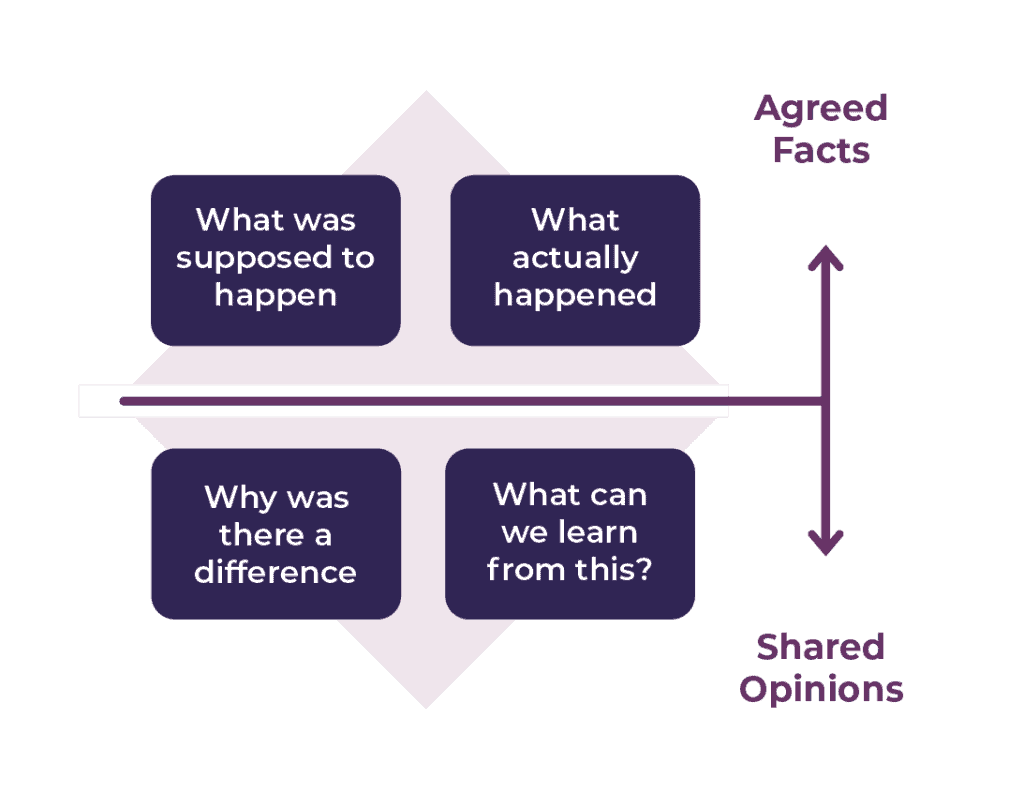
During an “after action review session”, you reflect on what happened, why it happened and how it can be done better.
- What did we set out to do?
- What did we achieve? Focus more on facts than opinions.
- What went really well? Again, look at the facts. Why did it go well? Compare the plan to reality.
- What could have gone better? Compare the plan to reality. What prevented us from doing more?
- What can we learn from this?

Go to Assignment 11.2: Conduct a mini After-Action review.
With the after-action-review assignment, you have completed the Evaluate module! Although this is the last module of the roadmap, if done correctly, decisions concerning monitoring, evaluation and learning should start at the planning and design phase of any initiative or programme you aim to implement (Module 2).
In this final module of the roadmap, you have been introduced to the key principles of PMEL and how these relate to the PMEL framework of RNW Media. As part of the PMEL cycle, this module has covered key elements including baselining for the different impact levels in the planning phase, the use of SMART indicators to be able to monitor performance at different result levels, outcome harvesting as a methodology to evaluate your programme as well as different methods to ensure continuous learning.
These are all key elements that allow us to monitor, capture, measure, evaluate and reflect on the performance and results. This is crucial to be able to continuously improve how you build your digital community for social change.