Develop: Define Relevant Digital Solutions
Develop: Scope down the focus based on your goals, resources, capacity & the competitors you face. Turn your potential solutions into prototypes that you test with your target audience to see whether your solution could work and where it needs improving. Based on user feedback, make changes and improvements before you spend time and money developing and/or implementing your solution.
The previous section has given you a broad overview of the type of channels that exist to reach your target audience. How can you determine which is the most appropriate channel to effectively reach your audience and achieve your intended goals? The video below gives you some clues on how to approach this question:
The table below gives an overview of some widely used channels, their main features and pitfalls.
As indicated in the table above, each social media channel has its own characteristics, purpose, advantages and disadvantages. Not all channels fit all purposes.
However, as the social media landscape is continuously changing, it is important to keep track of the developments and make sure you know where your target audience can be found and how they are using the different channels. The preferred digital communication channels by young people are always changing and can vary greatly by country or region.
Tip! Follow the course Anthropology of Social Media: Why We Post
This free five-week online course asks ‘What are the consequences of social media?’ by taking a comparative and anthropological approach to social media use around the world. It can be followed for free, and by its completion, you will have a more critical view on how people use social media in different contexts.
In addition to the taking into account the characteristics of the different channels, there are a number of other factors that need to be taken into consideration to be able to evaluate and choose the right channel.
What are your goals?
The selection of the most effective channel(s) depends on what your intended goal is. Every channel meets different objectives. People engage with content differently across channels and you need to select the one that best suits what you want to achieve.
Questions:
- Purpose: What do you intend to achieve (connect people, share information, engage…)?
- Type of content/medium: What type of content do you want to share on the channel (images, video, text)?
- Topics: What topics do you want to discuss? Not every channel is for example suitable for discussing sensitive topics.
- Algorithms: What algorithms does your channel use, and how could this potentially affect the success of your online content and the achievement of your intended goals?
What is your capacity?
Another aspect that can influence the choice of channel, is the required resources. This can be either the time it takes to set-up and reach desired results with a channel, the costs, or skills available to set-up and maintain the channel.
COMPONENTS SOCIAL MEDIA BUDGET
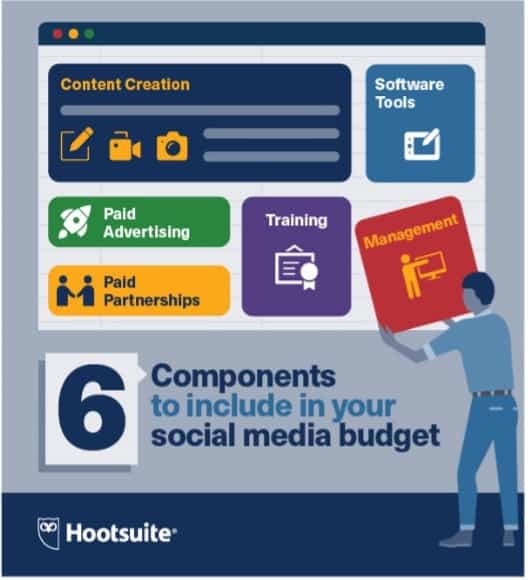
- Content creation accounts for a significant portion of your budget, and should cover photography, graphics, production and copywriting costs
- Software and tools include the costs for content hosting, SEO and keyword research, analytics tools
- Paid advertising: if paid advertisement is part of your social media strategy, besides organic content, make sure to budget for it
- Paid partnerships: if relevant, include budget for paid partnerships such as influencer marketing and co-branded campaigns
- Training: invest in training for your team (also explore free social media training resources)
- Social media management: have at least one person in-house supervising social media at least part of the time
Questions:
- Time and costs requirements: What are the required costs and time investments needed to use and maintain the channel?
- Skills: Do you have the skillset required to set-up and maintain the channel? What’s the ease-of-use?
What are your competitors using?
Analysing what your competition is doing can give you important insights to improve your own strategy. What content are they posting and on which channels? How successful are they in terms of reach and engagement? You can replicate their strategy or distinguish yourself from the competition.
Questions:
- Channels: What channels are you competitors using? How are they using the channel? What kind of content is shared on these channels?
- Performance: What is the success of your competition in using that channel? How many users are engaging with their content? How can you use these insights for the success of your own strategy?
Doing a competitor analysis is not only good for getting ideas of good practices, but also so you can avoid duplication of similar projects (with the risk of traffic being divided, leading to a lose-lose situation for you and your competitor – which can be especially damaging in the NGO sector) as well as foster potential partnerships and collaborations.
In conclusion, you can review the table below and make sure you answer all the questions.
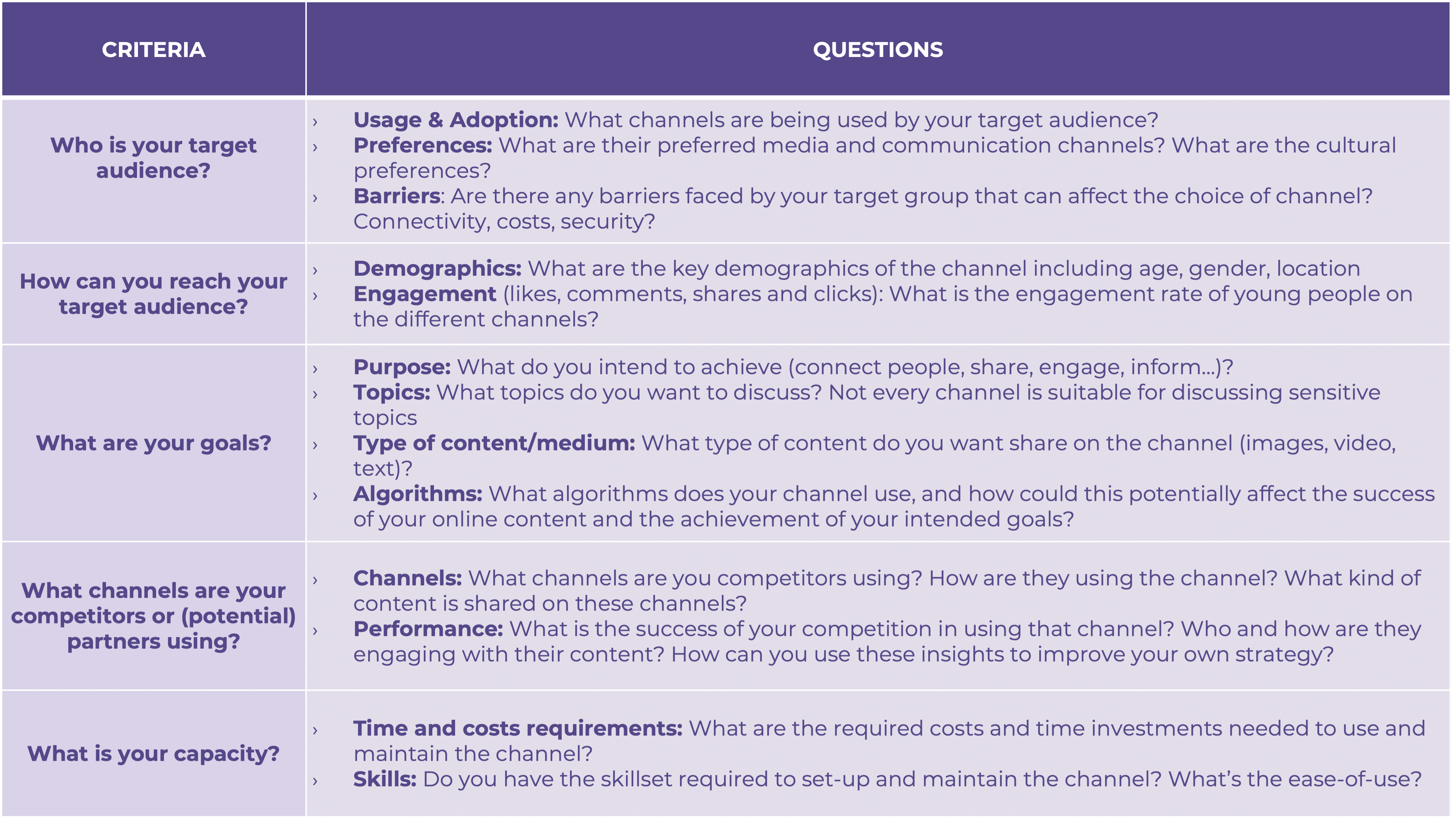
Tip! After you've completed you analysis, your digital project must have clear unique selling points (USPs) - only once you have a digital project with clear USPs should you start developing your channel strategy.
Channel strategy
In the previous assignments you have assessed various digital channels against various criteria to be able to select the most appropriate channel(s) to achieve your goals. This can form the basis of your omni-channel strategy.
The members of the LMGN use an omni-channel approach. Every year, the Love Matters Arabic team in Egypt holds a large meeting to map out initial content topics that will be featured each week of the year. Weekly content topics are also influenced by the comments and questions users post on the LMA discussion board. All weekly content topics are covered through each of the LMA digital channels – website, Facebook, Twitter, YouTube, SoundCloud and Instagram, but focusing on different angles of the same topic. Thus, messages on each platform reinforce each other and are not duplicative. As a result, end users visiting each LMA platform continue to be engaged with the same topic but learn something new about it or understand a different part of that topic.
Additionally, some topics are covered annually, but concentrate on a different aspect of that topic. For example, every year the topic of Family Planning is covered. One-year different family planning methods were highlighted, while another year focused on condoms and emergency contraception – highly stigmatized topics in Egypt. In a third year, the social influences and societal factors of family planning was addressed. In Egypt, there is a lot of pressure for newly married couples to have children. Thus, that year’s family planning messages focused on reinforcing to couples that the decision and timing of having children belonged to them, not their family or friends.
Omni-channel is a cross-channel approach that organisations use to improve their user experience and drive better relationships with their audience across points of contact. Rather than working in parallel, communication channels and their supporting resources are designed and orchestrated to cooperate. Omni-channel implies integration and orchestration of channels such that the experience of engaging across all the channels someone chooses to use is as, or even more, efficient or pleasant than using single channels in isolation.
With omni-channel, we focus on delivering the right content, on the right set of channels, at the right moment, to provide the most value to the user in the online and offline environments.