
Search Engine Marketing (SEM)
Search engine marketing (SEM) is the process of placing “pay per click” ad’s in search engine results pages. The major difference from SEO is that SEM is paid whereas SEO is organic.
Search Engine Optimisation (SEO) is the process of refining your website so that it will be indexed and ranked by search engines, as well as leveraging your links from other sites. Search Engine Marketing (SEM) advertising is advertising within search results and advertiser only pays when the user clicks on the advert. Both SEM and SEO are considered good approaches to Online Marketing Strategy.
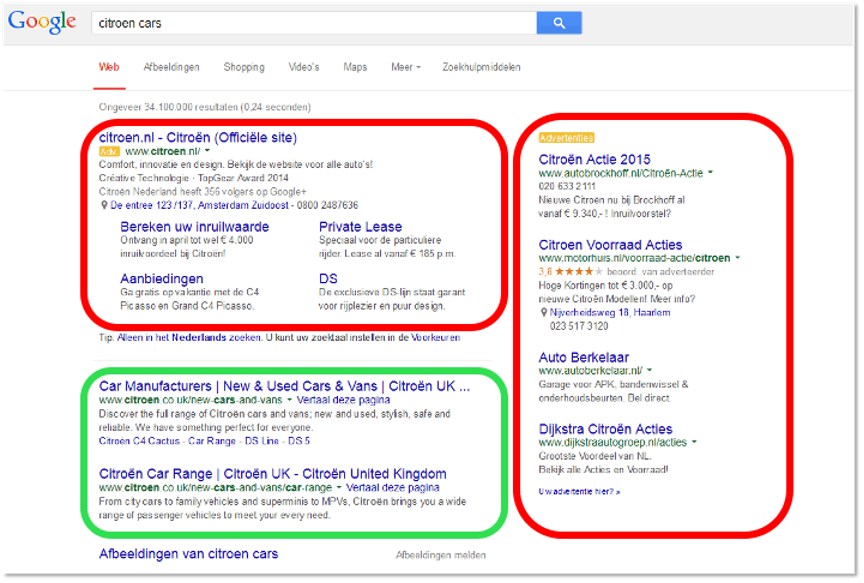
In the image above, the green sections of Google’s Search Engine Response Page (SERP) are organic search whereas the red sections are the paid responses. Click here for a video explainer.
Common Terms you will encounter in this section include:
- CPC (Cost per click)
- PPC (Price Per Click)
- Paid search
- Paid Search Engine Marketing (SEM)
- CTR (Click through rate)
- Impression: Number of views
- Conversion: when someone buys something, orders something or clicks on your link
Strategic considerations when to apply SEM
SEM requires a budget and therefore is a consideration for many organisations. SEM should be considered when:
- Organic ranking is weak
If your organisation’s website is in a highly competitive field or the name of the organisation is generic, ranking on Google will be lower. In some cases, so low that it will not easily be found by users. In this case it is advised to use SEM. It must be noted that Google’s algorithm immediately crawls pages that use advertisements, and this also increases the organic listing of the site over time. - Your organisation needs to strengthen visibility
In an important period it may be necessary to be highly visible. For instance during a disaster, a disaster relief NGO may want to be more visible. During elections, Citizen’s Voice may want to be more visible. - Early and immediate access to market is needed
If your organisation has set up a campaign and needs to be visible or if you have a new website and want to get seen, PPC is a way to begin to build traffic to your site.
Ads and campaigns
The starting point for SEM is an advert or a group of adverts or even bigger campaigns. Ads could be run one at a time or you may choose to run a series of ads with slightly different keywords or copy. Perhaps you want to specify the kind of term you would like to drive people to your site with.
A basic example is the common search term: how do I vote? Let’s say your Citizen Voice platform is creating lots of awareness around voting in a specific country. Each campaign may want to specify the city in the country: e.g. How do I vote in… Kinshasa, Goma, Lubumbashi, Mbuji-Mayi. These will all link to the same information page on voting and voting station information.
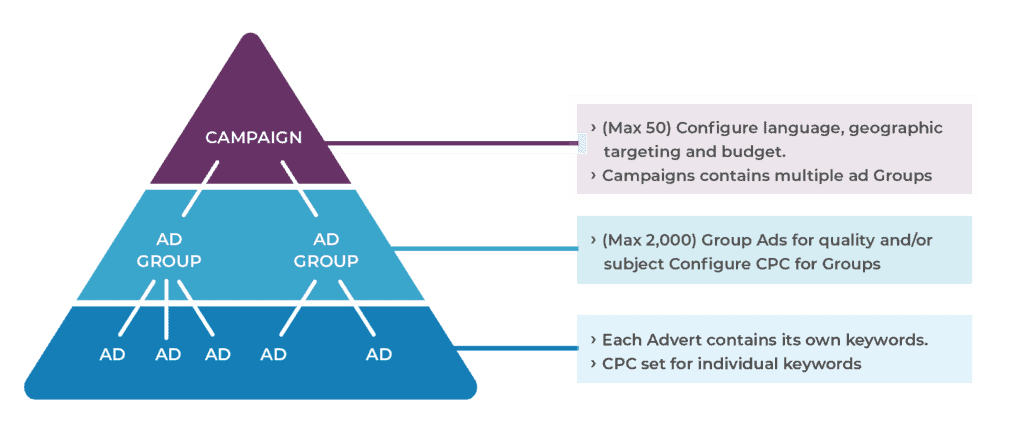
Ad goals
All marketing activities have a goal. It is very important to know what your goal is. This usually comes from a need that you have identified.
There are different goals:
- Sales: to drive sales to goods, services or conversions
- Leads: to gather information, data and contacts
- Traffic: to increase visits to website, content or campaigns.
Watch this video to learn more on setting goals.
The SEM flow
The flow of Search Engine Marketing from the creation of the advertisement to the results are detailed below as well as the actions that need to be followed. The mechanics of digital display and the various stakeholders are included below.
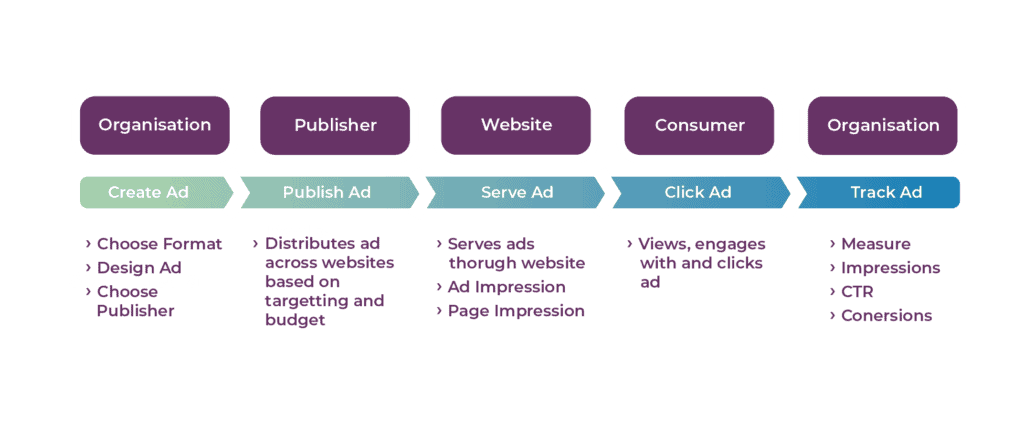
There are two major domains of ‘Pay Per Click’ these include display networks and Search Networks.
Search networks are the advertisements that appear in the Search Engine Response Page (SERP), these are text ads and appear on the top and the side bar of the search. Display Network is graphically rich online advertising presented in consistent size formats on webpages or across social media. Think of this as banner advertising. These are visual based and are on various webpages that have allowed advertising. Banner Ads are a popular type of digital image ad that can be placed across various websites. The largest and most popular image ad network is run by Google, and allows ads in the following common sizes:
- 250 x 250 – Square
- 200 x 200 – Small Square
- 468 x 60 – Banner
- 728 x 90 – Leaderboard
- 300 x 250 – Inline Rectangle
- 336 x 280 – Large Rectangle
- 120 x 600 – Skyscraper
- 160 x 600 – Wide Skyscraper
- 300 x 600 – Half-Page Ad
- 970 x 90 – Large Leaderboard
Much of this unit is dedicated to the Search Network, but the tools and techniques remain the same. It must be noted that there are certain drawbacks to using display network. ‘Banner blindness’ is a user’s ability to dismiss/disregard ads as they read a web page. We have become very good at excluding a lot of advertising messaging so typical click through rates depending on format can range from 0.1% to 0.3% on any banner. It is important to also note that this is for Google and Websites only, social media still has a much higher click through rate on their adverts.
You should be aware that Click Through Rates (CTR) is a blunt instrument for measuring the impact of digital display campaigns. A well-structured campaign could have significant brand and awareness raising benefits.
Keywords
Keywords are the foundation of search engine marketing. As users enter keywords (as part of search queries) into search engines to find what they’re looking for, it should come as little surprise that keywords form the basis of search engine marketing as an advertising strategy.
The exact same process as organic search is used in the researching and selecting of keywords. Keyword tools provide a range of valuable information, such as search volume for each individual keyword in Google and its general competitiveness (see the previous section on Keywords).
Long tail and short tail keywords
A short tail keyword is a phrase that contains 3 words or less. Examples include: “athletic apparel,” “DVD player,” or “engagement ring.” Short tail keywords are also known as “head terms”. They may be the first thing you think of when you are deciding where to go to eat (“Chinese food,” “pizza delivery”), what to do (“dance clubs,” “roller coaster park”), or where to worship (“synagogue,” “Catholic church”).
A long-tail keyword, however, is a little different compared to short tail keywords. Long tail words are phrases containing more than 3 words. They are definitely a lot more targeted and not as broad. You may not bring in as much search traffic from long tail keywords but the traffic you do bring in is the kind you are looking for.
Examples of long-tail keywords include: “summer women’s athletic apparel,” “super Blu Ray HD DVD combo player,” or “white diamond engagement ring.” Long tail keywords are obviously a lot more specific than short tail keywords; as a marketer this actually can work very much in your favour. But there are pros and cons to both types of keywords.
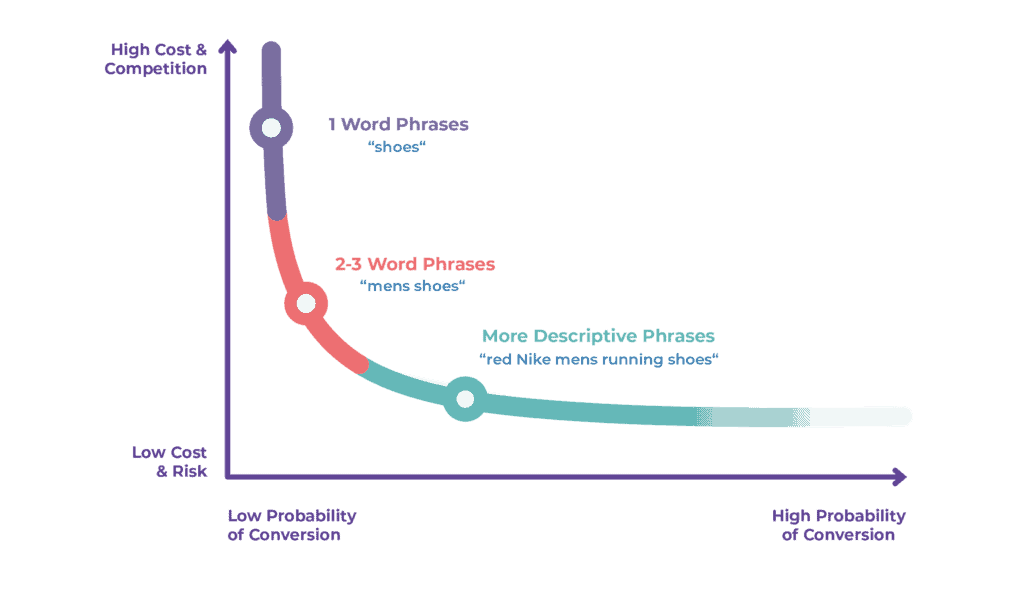
Short tail/head keywords are usually more expensive, have higher competition and also have much more impressions (seen by more people) but usually have lower probability of conversion.
Long tail key words have a high probability of conversion despite fewer impressions, they are cheaper with a greater return but they are very specific.
The Search Engine Marketing ad auction
One of the most enduring misconceptions about search engine marketing is that whomever has the largest advertising budget wins. Although a larger advertising budget can certainly be advantageous, especially when targeting highly competitive keywords, but it’s far from a requirement for success with search engine marketing. This is because all ads go through a process known as the ad auction before appearing alongside search results. For the purposes of this explanation, we will be focusing on the ad auction in Google AdWords.
The ad auction process takes place every single time someone enters a search query into Google. To be entered into the ad auction, advertisers identify keywords they want to bid on, and state how much they are willing to spend (per click) to have their ads appear alongside results relating to those keywords. If Google determines that the keywords you have bid on are contained within a user’s search query, your ads are entered into the ad auction.
Not every single ad will appear on every single search. This is because the ad auction takes a variety of factors into account when determining the placement of ads on the SERP, and because not every keyword has sufficient commercial intent to justify displaying ads next to results. However, the two main factors that Google evaluates as part of the ad auction process are your maximum bid and the quality score of your ads. Your quality score is determined by the following factors:
- Your click-through rate (CTR).
- The relevance of each keyword to its ad group.
- Landing page quality and relevance.
- The relevance of your ad text.
- Your historical Google Ads account performance.
Google calculates these metrics during the ad auction to determine placement of advertisements. The result of this calculation is known as ad rank.
Pay-Per-Click Marketing (PPC)
Pay-per-click marketing is a way of using search engine advertising to generate clicks to your website, rather than “earning” those clicks organically. Every time your ad is clicked, sending a visitor to your website, you pay the search engine a small fee. When a PPC campaign is well-designed and running smoothly, that fee will be trivial, because the visit is worth more to your organisation than what you pay for it.
Benefits of PPC
Having a solid PPC strategy is worthwhile for an organisation as:
- More than anything else it is the level of “Intent” revealed by the user that makes PPC marketing work, as the user is self-qualifying. This means that there is a person who is looking for your information, services or products. They want to find you.
- Your organisation has a ‘Relevance’ factor and can reach the right people who are interested.
- The organization approaches the right people at exactly the right time known as “Timing factor’.
- With Pay-Per-Click (PPC) you only pay for the clicks you get.
- It’s highly transparent and measurable leading to accountability.
- Visibility in search result is within your control.
Click Through Rates (CTR)
In digital marketing, CTR stands for click-through rate: a metric that measures the number of clicks advertisers receive on their ads per number of impressions.
Achieving a high click-through rate is essential to your PPC success, because it directly affects both your Quality Score and how much you pay every time someone clicks your search ad. No one outside of Google knows exactly how much each factor “weighs” in the Quality Score algorithm, but we do know that click-through rate is the most important component. When more people who see your ad click it, that’s a strong indication to Google that your ads are relevant and helpful to users. Accordingly, Google rewards you with: higher ad rankings & lower costs.
Click through Rate is the percentage of people who view your ad (impressions) and then actually go on to click the ad (clicks). The formula for CTR looks like this:
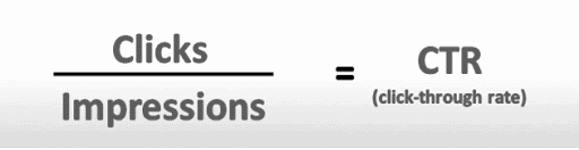
Total Clicks on Ad / Total Impressions = Click Through Rate
Generally, you can view your click-thru rate within the dashboard of your PPC account.
There are many factors that can affect your CTR including ad-copy, call to action, campaign structure or competitiveness of the bidding (how much you want to pay). Click through rates vary from sector to sector and there is no conclusive golden number of best or standard click through rate. The average CTR in AdWords is 1.91% for search. A good AdWords click-through rate is 4-5%+ on the search network.
Creating ads
Compelling, targeted text ads are crucial to a high-performance PPC campaign. They are often the first contact that a potential customer has with your site: they search for something related to your business, and your ad shows up in the results. Whether or not they click on your ad and get to your website depends on how powerful your message is and how relevant it is to what they want.
It is best to trial multiple ads until you find the ones that work: different wording, CTA etc., different landing page.
There are five steps in SEM Ads: plan, setup, build, track, monitor and repeat.
Ad copy
Well-written ad copy is critical to success. Qualities of well-written copy is that it is clear, concise, direct with an explicit call to action. Calls to action could be “Donate”, “Share”, “Sign up” or a range of other clear and direct calls to action.
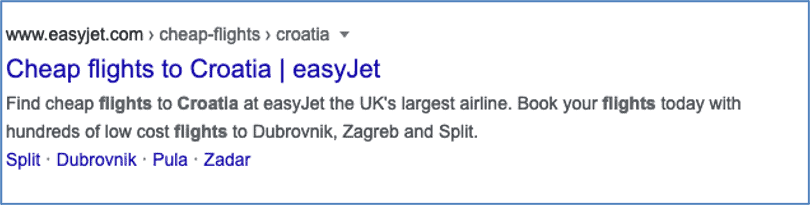
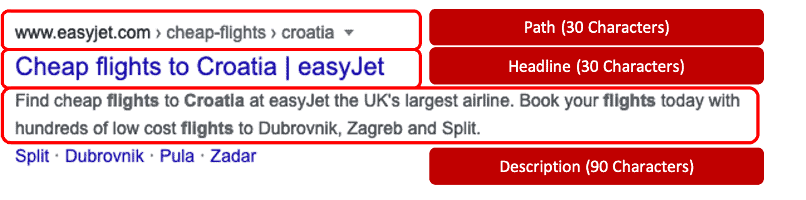
It consists of a headline, a display URL, and two lines of description. Each line of the ad has a limited character count; there’s an art to writing an eye-catching, compelling message that, ideally:
› Contains the relevant keyword at least once.
› Communicates your unique value proposition, i.e., the benefits of your offering and why people should visit your site to learn more.
› Includes a compelling call to action, or a command that tells the searcher what to do and what they’ll get when they click on the ad.
Below is a typical advert on Google and its structure:
Click here for a short explainer video on how to write text adverts.

Go to Assignment 7.2.7: Create a google ad.
Monitoring and optimising ads
Top-performing PPC advertisers are always testing and tweaking their ads to find the most compelling messaging for each keyword group, in order to maximise clicks and Quality Score and ultimately lower cost per action. Monitoring and analytics are discussed in a later section of the roadmap. But it is important to note that during a SEM campaign monitoring and analytics will need to be increased to iterate the ad you are running.
Click here for a short explainer video on how to track your goals and conversions.