
Assignment 9.9: Power analysis exercise (optional)
- This is exercise is most effective if you work on it as a team to be able to reflect and discuss. Feel free to reflect yourself using your learning journal or pen and paper.
- In this assignment you will make a power analysis by drawing an YX Graph.
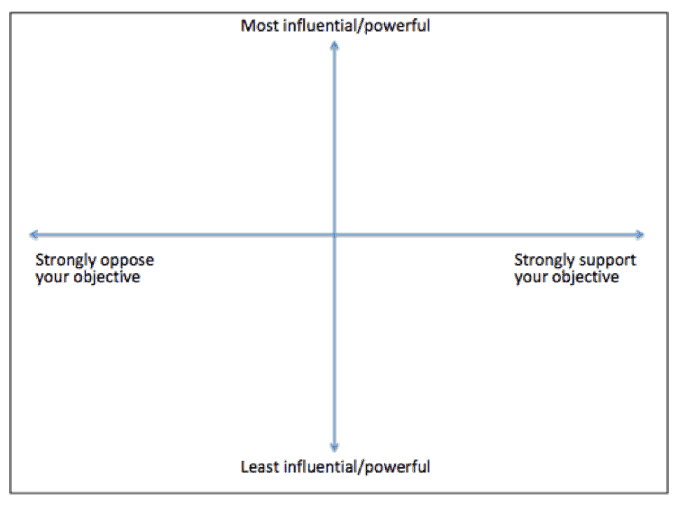
- The horizontal line, X axis: refers to how supportive some-one is of the advocacy issues.
The vertical line, the Y axis: refers to the power people have in relation to /over the issues.
Choose a case to carry out your power analysis or use the advocacy objective of your team you have improved in the optional assignment 8
- Case 1 SRHR: To ensure that young women can access safe abortion services in country Z
- Case 2 CV: To advocate for increased participation of young women in politics at the national level
- Your own team’s advocacy objective of assignment 8
Listing stakeholders:
- Who has an interest in dealing with the issue?
- Who has a reason to block it?
- Who is affected by the issue?
Be specific:
- List names instead of institutions
- Who are the direct – indirect targets?
- Think strategically – for example, you might need to target the opposition parties, not only the governing party, or target all religious leaders, not only those from the main religion.
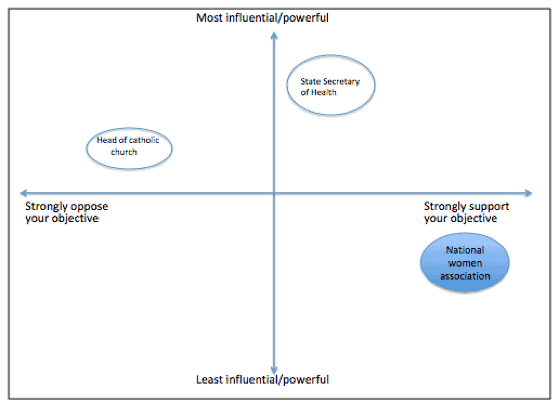
Plot the stakeholders on the XY graph given that:
- The more powerful and influential, the higher on the map, and
- The more supportive of your advocacy objective the further on the right hand-side (‘neutrals’ stand in the middle, on the Y- axis, enemies on the left).
Reflect:
- Have you identified indirect and direct targets?
- Do you consider targets as allies or enemies?
Remember that targets are not automatically your enemies and that it is usually beneficial to treat targets as allies and to find the common ground that they share with them. As an advocate you can “offer your help” to a decision maker to get the issue going. As RNW Media, the nature of our digital platforms is non-confrontational, which makes a collaborative approach more in line with the identity of RNW Media. In RNW Media’s Advocacy Framework, collaboration with lobby and advocacy partners is also encouraged.
The aim of this exercise was to learn how to identify targets and to prioritise them. It is important to do such an activity for each advocacy objective as they usually have different targets. Some useful criteria to keep in mind when prioritizing targets: their impact, if they are ‘easy’ to work with, if they cannot be ignored. Know when to switch targets! Do not spent too much time knocking at closed doors.
What else do we gain from a power analysis besides identifying and prioritizing targets?
| Why conduct a Power Analysis? It is useful to do a power analysis, as it helps us to: Explore who our allies and opponents are, and who is neutral. See the hierarchy of where we need to focus our work. Plan strategically Tailor our messages to allies and opponents Choose the most appropriate methods and activities |
After you have conducted the power analysis (step 4), you decide who your targets (6) are and who your allies/partners (5) are.